BREAKING: Target Test Prep releases Brand New 2026 On Demand GMAT prep course
RedeemHow to Tackle Every Single GMAT Problem (Seriously!) - Part 4
 Welcome to the fourth installment of our series: how to tackle every problem on the GMAT. If youre joining in the middle, go back and learn about the set of principles that tie together everything we need to do on the GMAT. Then work your way back to this installment.
Heres our framework again:
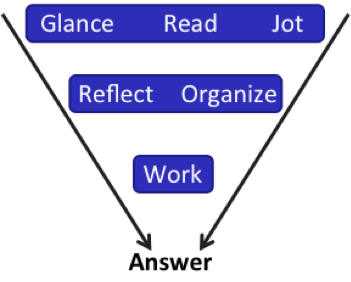
I finished off part 3 with the following GMATPrep problem from the free exams. Lets use the SC process to answer it now.
The new image of Stone Age people as systematic hunters of large animals, rather than merely scavenging for meat, have emerged from the examination of tools found in Germany, including three wooden spears that archaeologists believe to be about 400,000 years old.(A) merely scavenging for meat, have emerged from the examination of tools found in Germany, including
(B) as merely scavenging for meat, have emerged from examining tools found in Germany, which include
(C) as mere meat scavengers, has emerged from examining tools found in Germany that includes
(D) mere scavengers of meat, has emerged from the examination of tools found in Germany, which includes
(E) mere scavengers of meat, has emerged from the examination of tools found in Germany, including
Ready?
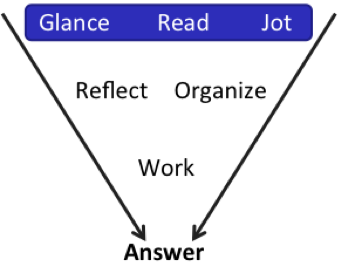
Glance: What have we got?
than merely
Im wondering what the than is a part of, so my eye goes a little further back:
rather than merely
Oohcomparison! What about the beginning of the answers?
(A) merely scavenging(B) as merely scavenging
(C) as mere meat scavengers,
(D) mere scavengers
(E) mere scavengers
All right, weve got an X rather than Y comparison structure. Were going to have to figure out what the X is and that will indicate what form we need to choose for the Y. (You may decide to jot down X rather than Y to remind yourself to address this issue.)
Time to Read the sentence! Whats it saying?
The new image of Stone Age people as systematic hunters of large animals, rather than merely scavenging for meat, have emerged from the examination of tools found in Germany, including three wooden spears that archaeologists believe to be about 400,000 years old.
Strip that down to the core:
The new image of (some) people as X, rather than Y, have emerged from the examination (of tools).
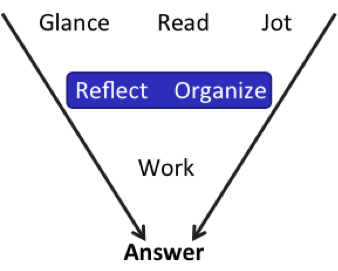
What do you notice?
Wait a sec: theres an error in the core sentence! You can choose to stick with the original comparison issue, or you can switch gears and Work on the subject-verb issue first. Im going to do the latter:
The new image have emerged.
No way! Image is singular, so it should say the new image has emerged. Say goodbye to answers (A) and (B).
Answers (C) through (E) are all okay on this point, so now loop back around. Luckily, weve already identified the second potential issue: that comparison.
The new image of (some) people as systematic hunters of large animals, rather than Y, have emerged from the examination (of tools).
X is hunters (of large animals), so Y should be in the same noun form. Hmm. This is another reason to get rid of (A) and (B), but (C) through (E) all use the proper match, scavengers.
Aside: Im not thrilled with mere meat scavengers in (C). Id prefer mere scavengers of meat, as in (D) and (E). But there isnt a strong grammatical reason why I couldnt use mere meat scavengers, so Im going to ignore that and look for something else. Loop around again!
Now, when youre down to a small number of choices, compare the remaining answers, looking for differences. There are a couple, but theyre all actually part of a big modifier, so I recommend looking at them as one big chunk:
(C) from examining tools found in Germany that includes(D) from the examination of tools found in Germany, which includes
(E) from the examination of tools found in Germany, including
The three structures at the end are used for three types of modifiers.
That includes, in (C), signals an essential noun modifier: the modifier must be included in the sentence or the basic meaning of the core sentence will be nonsensical.
Further, the noun should be as close as possible to the modifier. In this case, the noun Germany is right before the comma. Logically, the modifier should refer to tools. In certain circumstances, it is possible to have a short separation of the noun and the modifierbut is it okay in this case to say that the that includes modifier refers back to tools, with a short found in Germany modifier in between?
Try it out:
from the examination of tools that includes
Oops. No, its not possible in this case because tools is plural and includes is singular. Logically, the modifier points to tools, but structurally it points to the singular Germany (or maybe even the singular examination?). None of these works; eliminate (C).
Can you use the same reasoning to eliminate either (D) or (E)?
Yes! Answer (D) changes the modifier to the non-essential structure comma which includes, and this modifier has the same problem: includes would have to be plural in order to point to tools. Eliminate (D).
But wait a second. Answer (E) doesnt seem to be doing what its supposed to be doing either. It uses a comma ing modifier:
The new image of (some) people as X, rather than Y, has emerged from the examination of tools found in Germany, including (some spears).
A comma ing modifier refers back to the entire preceding clause, but is it really the case that the three spears refer back to the image has emerged from the examination?
Weve just uncovered one of the few exceptions to the general comma ing rule: when using the word including, the sentence really can just be giving examples of something (usually a noun) that was named shortly before the comma. Unlike the modifiers in answers (C) and (D), the including modifier in (E) does not contain a verb that needs to match the noun tools, so there are no problems with the construction.
All right, are you ready to try out the GRW process on Critical Reasoning?
According to the Tristate Transportation Authority, making certain improvements to the main commuter rail line would increase ridership dramatically. The authority plans to finance these improvements over the course of five years by raising automobile tolls on the two highway bridges along the route the rail line serves. Although the proposed improvements are indeed needed, the authoritys plan for securing the necessary funds should be rejected because it would unfairly force drivers to absorb the entire cost of something from which they receive no benefit.Which of the following, if true, would cast the most doubt on the effectiveness of the authoritys plan to finance the proposed improvements by increasing bridge tolls?
(A) Before the authority increases tolls on any of the area bridges, it is required by law to hold public hearings at which objections to the proposed increase can be raised.
(B) Whenever bridge tolls are increased, the authority must pay a private contractor to adjust the automated toll-collecting machines.
(C) Between the time a proposed toll increase is announced and the time the increase is actually put into effect, many commuters buy more tokens than usual to postpone the effects of the increase.
(D) When tolls were last increased on the two bridges in question, almost 20 percent of the regular commuter traffic switched to a slightly longer alternative route that has since been improved.
(E) The chairman of the authority is a member of the Tristate Automobile Club that has registered strong opposition to the proposed toll increase.
Try that problem out and well talk about it next time!
Key Takeaways for Every Problem You Will Ever Do:
(1) First, see whether a quick look can give you an early idea of what the question may be testing. On SC, glance at the word right before the underline and at the first word of the underline: any clue markers there? Next, compare the first word or two of each answer choice: do the differences signal any particular issues?
(2) Next, Reflect on what youve been given and Organize your thoughts. If youre lucky, youll spot more than one potential issue to tackle. In that case, pick the issue that you think is the easiest or most straightforward.
(3) When you know youve got an error, cross off that answer choice and any others that repeat the same error. Once youve finished dealing with the first potential issue, youll likely still have more than one answer left, so its very useful if you came up with two ideas to start. Now you know exactly what youre going to tackle next!
* GMATPrep questions courtesy of the Graduate Management Admissions Council. Usage of this question does not imply endorsement by GMAC.