BREAKING: Target Test Prep releases Brand New 2026 On Demand GMAT prep course
Redeem4 Steps to Get the Most out of Your CATs - Part 1
 How many practice tests have you taken so far? Are you satisfiedor frustratedwith your progress?
One of the biggest mistakes I see students make is also relatively easy to fix: they dont learn what they should be learning from their practice tests. This is exactly what were going to talk about today.
#1 You dont get better while taking a CAT
Wait, how is this a step to get the most out of your CATs?? Read on.
Have you ever done this? You take a test, but arent happy with your score, so within a week or so, you take another test.
Bad move! First, you already have all of the info that you need in that first test; your skills arent going to change radically in a week. You just wasted 4 hours of valuable study time (not to mention, one of your limited practice tests!) in order to get the same data that you already know.
Alternatively, have you read online that someone out there took 14 practice tests in a 6-week period and swears by this method of studying because he then got a 760? If you do just what he did, youll get a 760 too!
Sadly, theres a very good chance you wont. Do you remember that one kid from your school, the one who was always excited when the standardized test days came around? She was super annoying because she just did well on these tests naturally and she actually liked taking them. (Yes, that was me.)
Heres the thing: if these tests already just make sense to you, then sure, the brute force approach is likely to work. The thing is: those of us who can do this ARE actually analyzing this stuff just as much as you need to, but we do so more quickly than most, and almost without being aware that were doing it. The brute force method works for perhaps 1% of the population and if it were going to work for you, youd already know it.
The first step, then, is to make this mindset switch: youre going to use your CATs to practice what youve already learned and to provide data to help you continue to learn after the CAT is over. You should be able to find a bare minimum of 2 weeks worth of things to do based on your assessment of one CAT. That takes us to step #2
#2 Use your CATs to learn your Strengths and Weaknesses
Sometime early on in your study, youre going to take a practice test. Dont put this off! You need to know your strengths and weaknesses so that you can set up your study plan and prioritize the right things.
In fact, thats the single biggest value of taking a practice test: learning your strengths and weaknesses and using that data to inform your study for the next 3 to 6 weeks until you take another practice test.
I'll base my discussion on the metrics that are given in ManhattanGMAT tests, but you can extrapolate to other tests that give you similar performance data. You will likely need at least 60 minutes to do this analysis, not counting any time spent analyzing individual problems.
Before you start the analysis itself, learn what the GMAT really tests. (Seriously, go read that right now, then come back here.)
First, naturally, look at the overall score! Did you do the essay and IR sections? If not, assume the Quant + Verbal score is a little inflated because you wouldnt have been as mentally tired as normal when you got to those sections.
Ditto if you used the pause button, took extra time, took longer breaks than allowed, or did anything else that wouldn't be allowed under official testing guidelines.
The not-so-hidden message here: it really is best to take a full test (including essay and IR) under 100% official conditions. Youll get the best data and the most realistic picture of your current skill set and scoring level.
Next, pull up the problem list for each of the 3 sections with multiple choice questions (Quant, Verbal, and IR). The problem lists show each question, in order as you took the test, as well as various data points about those questions.
Correct / Incorrect Column
Any strings of 4+ questions wrong?
- If so, look at time spent. Were you low on time and rushing?
- Alternatively, were they really hard? Maybe you should have gotten them wrong.
- Think back to how you felt on these problems. A common scenario: the first one or two are really hard, so you spend extra time. You get them wrong because theyre hard. You know you spent extra time, so you speed up on the next couple and make careless mistakes, getting those wrong as well.
Cumulative Time vs. Target Cumulative Time
How closely did you stick to the expected timeframe? Its completely normal to be off by + / - 2 minutes, and Im not too concerned as long as youre within + / - 3 minutes.
- Are you 3+ minutes behind (too slow)? If so, where was that extra time spent? How well did you really do on those problems? (They should be all or mostly correct, since you chose to allocate extra time to them! If not, start cutting yourself off.)
- Are you 3+ minutes ahead (too fast)? If so, where are you picking up that time? How well did you do on those problems? If you knew you didnt know how to do a problem its fine to answer fast. If you were going quickly because you did know how to do it, though, then be careful: thats a recipe for careless mistakes.
Time Column
Even if your cumulative time was fine, you might still exhibit a very common problem: up and down timing. This is when you spend way too much time on some problems and then speed up on others to catch back up. Your overall timing works out, but you still have a serious timing imbalance on individual problems.
Click on the Time column itself. This will re-sort the questions from fastest to slowest.
- How many too fast questions did you miss or get right via luck? If you knew you didnt know how to do the problem and chose to guess quickly, then you dont need to count that problem.
- How many too slow questions did you miss? You should have cut yourself off faster!
- Did you have any crazy-slow problems (e.g. double time)? Even if you got it right, maybe you should have gotten it wrong much faster and spent that time elsewhere.
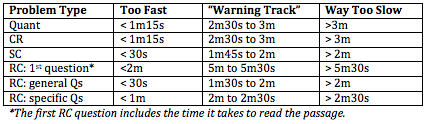
Here are the timing metrics by Quant and Verbal problem type:
Here are the timing metrics for IR, depending on your skip strategy*:
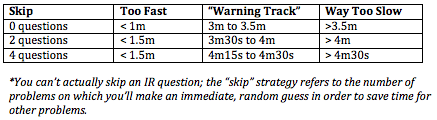
If you have more than a few questions in the too fast or too slow categories (regardless of whether theyre right or wrong), then youve got a timing problem. For example, if you had 4 questions over 3m each, then you almost certainly missed other questions elsewhere simply due to speedthat extra time had to come from somewhere. You know those times when you realize you made an error on something that you knew how to do? Well, if you were also moving even a little bit quickly on that problem, your timing was at least partially a cause of that error.
Alternatively, if there is even one that is very far over the way too slow mark, you have a timing problem. If you have one quant question on which you spent 4m30s, you might let yourself do this on more questions on the real testand there goes your score. (By the way, the only potentially acceptable reason is: I was at the end of the section and knew I had extra time, so I used it. And my next question would be: why did you have so much extra time?)
For each section, get a general sense of whether there is
- not much of a timing problem (e.g., only 1 or 2 questions in the too fast or warning track range),
- a small timing problem (e.g., 3 questions in the warning track range, or 1 problem in the way too slow category, plus a few way too fast questions), or
- a large timing problem (e.g., 4+ questions in the warning track range, or 2+ questions that are way too slow, plus multiple way too fast questions).
Note that I dont specify above whether the warning track and too slow questions were answered correctly or incorrectly. It isnt (necessarily) okay to spend too much time just because the question was answered correctly.
Try to figure out roughly how bad the timing problem is. How many problems fit into the different categories? Approximately how much time total was spent on the way too slow problems? How many too fast questions did that cost you or could it have cost you? (If you answer something correctly in under 30 seconds assume you got a little lucky that you did not make a mistake.) Examine the problems themselves to locate careless errors. How many of your careless errors occurred when you were rushing or just plain tired out because you'd spent too much mental effort on a too-hard problem?
Finally, are there any patterns in terms of the content area? For example, perhaps 80% of the "too slow" quant problems were problem solving problems or two of the "too slow" SC problems were modifier problems. Next time, were going to talk about how to use the assessment reports to dive more into this data, but do try to get a high level sense of any obvious patterns.
All of the above allows you to quantify just how bad any timing problems are. Now, Im going to make a pronouncement that will wow you: you have a timing problem!
Actually, we all have timing problems. The question is just what yours are and how significant they are. If youre having trouble letting go on hard questions, read this.
Everyone should read this article on time management.
Now were done looking at the problem lists; in the second half, well analyze the data given in the assessment reports.