BREAKING: Target Test Prep releases Brand New 2026 On Demand GMAT prep course
RedeemGMATPrep Quant Question, Part Two: What is this?
 Recently, I gave you a GMATPrep question and started out by asking What is this thing, anyway? Ive got another one (along similar lines) for you this week (also a GMATPrep problem).
By the way, I love this problem. Yes, I know Im a complete dork. But it does such an amazing job of disguising whats going on, and it looks deceptively simple, but then its hard to figure out an efficient way to tackle it. Theres so much to learn on this one thats why I love it.
Try it out (2 minutes!):
Are x and y both positive?(1) 2x 2y = 1
(2) [pmath]{x/y}[/pmath]>1
It cant be that hard, right? Its just asking whether theyre positive, and the equation and inequality look pretty simple, and well, lets see how we do.
This is a theory question, first of all. How do we know that? Because theyre asking whether something is true, that thing is a characteristic (in this case, positive), and the information they give us is clearly not enough to determine a single value for x and y. Therefore, those statements are actually disguising other characteristics that can help us to tell whether these variables are always positive.
Second, this seems to be testing us on number properties theory. The first clue is that word positive. Are there others? Well, sort of but theres something a little off. That second statement, the inequality, looks a little different than Id normally expect for a pure positive / negative theory problem. In a pure problem, theyd tell me that x/y was greater than zero (or less than zero, or something related to zero). But this one says 1, not 0, so Im going to need to figure out the significance of that.
(Note: at the beginning of the previous paragraph, I said that the question seems to be testing NP theory. I dont want to mislead you with my language: it is testing that, but it may also be testing something else. I havent figured that out yet. Im just intrigued by the 1 in that inequality. :))
Okay, so the question itself is pretty straightforward. I do need to make sure I remember that theyre asking about both of the variables, so I write that down on my scrap paper.
Next, do I start with statement 1 or statement 2? If statement 2 said [pmath]{x/y}[/pmath]>0, I would definitely start with that, because I already know what it means (from previous study). I decide to start with that one this time, too.
(2) [pmath]{x/y}[/pmath]>1
At the least, I know that x and y have the same sign, because greater than 1 is also telling me that its positive, and when you divide one number by another, they have to have the same sign in order to result in a positive number. Ive just figured out one really important thing actually: if any future information does tell me that either x or y is positive (or negative), then I know the same is true of the other variable. I only actually need to determine the sign of one of them now.
Can I tell whether theyre both positive or both negative? Nope, not just via statement 2; either outcome is possible. Great; I can eliminate answer choices B and D.
Now I have a choice. I know theres more to learn about statement 2 because I havent yet figured out why they put 1 here instead of 0. But I also know that this statement is insufficient, and I havent looked at statement 1 yet. If it turns out that statement 1 is sufficient, I dont have to worry about why they put 1 here for statement 2. So I decide not to keep working on statement 2 right now, but Im going to keep this question in the back of my mind in case I need to come back to it: What is the significance of saying >1 instead of >0?
(1) 2x 2y = 1
Hmm. Just looking at that, I dont really know what the significance is. I am a little annoyed by the fact that I dont have pure variables, so I decide to divide by 2:
x y = [pmath]1/2[/pmath]
And then I dont like the subtraction sign so much:
x = y + [pmath]1/2[/pmath]
Okay, I can translate that into normal-person-think: x is larger than y and its specifically larger. The two variables, then, are not both integers, and possibly neither one is.
Does that tell me anything about whether theyre positive or negative? Nope. I can think of numbers where theyre both negative, x is positive and y is negative, or theyre both positive. Okay, so statement 1 is not sufficient and now I am going to have to go back and figure out whats going on with statement 2. Cross off answer A.
(2) [pmath]{x/y}[/pmath]>1(1) x = y + [pmath]1/2[/pmath] (note: this is my manipulation of statement 1, not the original)
Okay, so I know now that x and y have the same sign, and that x is larger by . I can try some numbers now to try to understand whats going on, or I can think theoretically. Well start here by trying numbers and use that to show what is actually going on theoretically. If you can then learn the theory, you wont have to try numbers next time!
So lets start with a positive pair because, hey, positive numbers are easier. Lets try y = 2 and x = 2.5. (remember that x has to be the larger of the two). Hmm 2.5 / 2 equals something larger than 1. This always has to be true because 2/2 = 1, so (something larger than 2)/2 has to be larger than 1.
Okay, so in this case, the answer to our original question (are x and y both positive) is yes. But what about negative numbers could those work too? Lets test a pair.
Lets try basically the same numbers: y = -2 and x = -2.5. What do we do first?
We stop. Be really careful when you flip the numbers. The x must be larger, and -2.5 is not larger than -2. We need to try something like y = -2.5 and x = -2. Hmm -2 / -2.5 = 2 / 2.5 = 2 / (5/2) = 4/5. Thats less than 1, so this pair isnt a valid pair to test Im required to pick something that makes statement 2 true (x/y > 1). But is there another pair of negative numbers that will work, a pair that does make statement 2 true?
Before, we said that 2/2 always equals 1, and that therefore (something larger than 2) / 2 would always be larger than 1. Guess what? We can reverse that, too. In this case, 2.5 / 2.5 = 1. (something smaller than 2.5) / 2.5 = something smaller than 1. Not sure? Its annoying having a fraction on the denominator here, isnt it? Okay, lets try a different pair: y = -2 and x = -1.5. -2 / -2 = 2/2 = 1. -1.5 / -2 = 1.5 / 2 = less than 1. Easier to see with that example, isnt it?
So, the only numbers that will make both statements true are positive numbers therefore, we can definitely say that x and y are both positive using the two statements.
The correct answer is C.
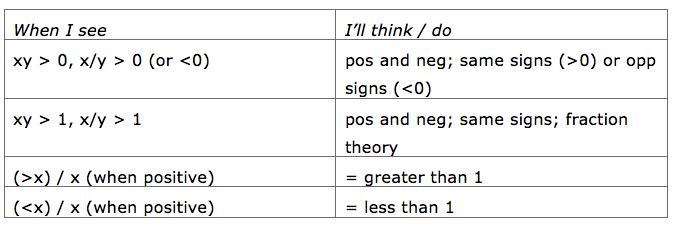
Here are the fraction rules that we just deduced (assume that we know that zero is not a possibility, as statement 2 told us in this problem):
[pmath]x/x[/pmath] = 1 (of course!)
If the numerator and denominator have the same sign, then turn both top and bottom to positive. Then:
(1) (something larger than x with the same sign) / x = greater than 1
(2) (something smaller than x with the same sign) / x = less than 1 (and greater than zero because they have the same sign!)
What about statement 2? In future, when you see [pmath]{x/y}[/pmath]>1, youll know that this is testing you on both number properties and fraction theory. This statement tells you that the two variables have the same sign. If (after turning the numerator and denominator to the positive), youre also told that the numerator is the larger number, then x and y are both positive. The converse is also true: if were told the numerator is the smaller number, then x and y are both negative.
Not sure why? Test it out in the same way that we tested out the other scenario above and convince yourself. And if you forget in the moment, you can always test out a number or two to figure out the rule.
Key Takeaways:
(1) The GMAT test writers are experts at writing deceptively simple-looking and really quite hard problems. Many of these problems are testing math theory and you can often handle these by picking numbers and testing things out. This takes time, though, so dive in right away, and lots of practice youll get faster as you practice more. Note that sometimes youll still just have to let go.
(2) If you havent already, create a When I see X, Ill think / do Y file or set of flashcards. Things to add:
* All quotes copyright and courtesy of the Graduate Management Admissions Council. Usage of this material does not imply endorsement by GMAC.