BREAKING: Target Test Prep releases Brand New 2026 On Demand GMAT prep course
RedeemBreaking Down A GMATPrep Divisibility Problem
 Weve got another GMATPrep word problem on tap for today, but this ones in the area of divisibility (number properties). These kinds of problems often include a lot of math vocab; we need to make sure both that we understand the precise words used and concepts being described and that we dont forget or overlook any of the pieces.
Set your timer for 2 minutes and GO!
If m is a positive odd integer between 2 and 30, then m is divisible by how many different positive prime numbers?(1) m is not divisible by 3.
(2) m is not divisible by 5.
Vocab. Positive odd integer. Okay, that includes numbers like 1, 3, 5 oh, wait, between 2 and 30. So m could be 3, 5, 7, all the way up to 29.
In fact, thats not all that many possibilities for m; I could write them out if I wanted to. Im not going to yet, but Ill keep that in mind.
The question is a little more confusing. They ask about different positive prime numbers. 2, 3, 5, and 7 are different positive prime numbers. Whatever m is, its going to be divisible by some prime number or numbers, and were supposed to figure out how many. Not which prime numbers will divide m, just how many. Thats interesting. I can also reword the question as: m has how many different positive prime factors? (Note: you can keep the original wording if you prefer; use whichever wording makes the most sense to you.)
If I can find the value of m, then I can answer the question. But is that the only way to answer the question do I have to find the value of m? Is it possible that I might not know what m is, but I could still answer the question? Could m have multiple possible values that still all give me the same answer?
Lets see. If m is 3, then its divisible by exactly one prime number: 3. If m is 5 hey, then its also divisible by exactly one prime number: 5. So if they told me that m is equal to either 3 or 5, then I could answer the question, even though I dont know exactly what m is or even what the one number is that does divide m (it could be 3 or 5). How weird.
And that little analysis is leading me towards an idea of how I need to approach this question. Ive decided I actually am going to write out the positive odd integers between 2 and 30 on my scrap paper. Then, Im going to figure out the prime factors of each one.
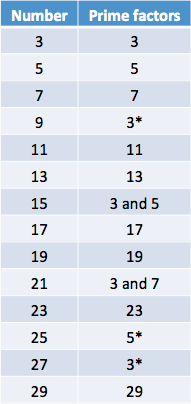
* Remember that the problem asked for the number of different prime factors. 9 is made up of three times three; it has only one different, or distinct, prime factor. The same is true of 25 and 27.
That is really interesting! Before I did this problem, I never thought about this information in this way. 9 isnt prime, but has only 3 as a prime factor. 25 and 27 are similar theyre not prime, but have only one prime factor. In fact, only 15 and 21 have 2 prime factors. Out of all of those odd numbers, all but 2 have exactly one distinct prime factor and thats it! And the other 2 have exactly two prime factors.
I can rephrase the question a bit further. If I know m is either 15 or 21, then the answer to the question is sufficient: 2 distinct prime factors. If I know that m is NOT 15 or 21, then the answer to the question is also sufficient: 1 distinct prime factor. If I have a mix of 15 or 21 and at least one of the other numbers, then I cant answer the question.
Okay, back to our question. Statements 1 and 2 look pretty equal in terms of difficulty, so Im going to start with statement 1. I also notice that they look almost identical just the number is different. Often times, two nearly-identical statements will mean that they either both work or both dont work but Im kind of skeptical on this one. The only reason Im skeptical is that the set-up so far has been unusual; I havent seen a problem before that has asked me to think about the data in this way, and that data actually only gives 2 broad categories so Im thinking theres a trap here somewhere.
Statement 1 says that m is NOT divisible by 3. Put little xs (or some other symbol) next to all of the multiples of 3 in your chart. Notice anything about whats left?
Both 15 and 21 drop out, because both are multiples of 3. Hey, thats great! That means that the numbers that remain all have exactly one distinct prime factor and we can answer the question. Statement 1 is sufficient. Cross off answers B, C, and E.
Statement 2 says that m is NOT divisible by 5. If youre doing statement 2 second, you can actually just cross off all of the multiples of 5 now (our next step, if necessary, will be to combine the two statements, so this information will be valid for the rest of the problem). Whats left?
15 is out, but 21 is still in. And so are some of the other numbers (for example, 3 is still in). Ive got some numbers that have 1 distinct prime factor and 21, which has two distinct prime factors. Thats insufficient. Cross off answer D.
The correct answer is A.
Key Takeaways for Wordy Divisibility Problems:
- Definitions and terms will be important. These will often be stacked throughout the text of the problem and youll need to make sure you deal with every single one. Make sure you have efficient ways to write down all of the pieces of information; study how to combine or translate multiple concepts grouped together.
- If you havent figured out the significance of some word or term, it deserves your attention. Dont just gloss over it. A single word can make all the difference. What if the problem above had not included the word different? How would that have changed things?
- Number properties problems in Data Sufficiency form often benefit from some upfront work on the question stem before you ever look at the statements. (This is often true of DS in general, but especially so on number properties topics.) Do the details limit the possibilities in some way? Figure out what the limits are. Do we need to find one exact number? Sometimes yes, but often no; know when you do and when you dont. Take the time to understand whats going on. Its worth it.
* GMATPrep questions courtesy of the Graduate Management Admissions Council. Usage of this question does not imply endorsement by GMAC.