BREAKING: Target Test Prep releases Brand New 2026 On Demand GMAT prep course
RedeemManhattan GMAT Challenge Problem of the Week - 28 June 2011
Here is a new Challenge Problem! If you want to win prizes, try entering our Challenge Problem Showdown. The more people that enter our challenge, the better the prizes!
Question
If, for all integers n 1, [pmath]x_n[/pmath] is the probability of selecting at random an integer with an odd number of unique positive factors from among the positive integers less than or equal to [pmath]n^2 [/pmath], then the sum of the first 5 values of [pmath]x_n[/pmath] is(A) less than 1
(B) between 1 and 2
(C) between 2 and 3
(D) between 3 and 4
(E) greater than 4
Answer
According to the question, [pmath]x_n[/pmath] is the probability of selecting at random an integer with an odd number of unique positive factors from among the positive integers less than or equal to [pmath]n^2[/pmath]. That definition contains a lot of words. Lets simplify by focusing on just one value: [pmath]x_1[/pmath].
Plug in 1 in place of n. Now, because we are examining a complicated probability scenario, we should ask ourselves two questions.
(a) What is the pool we are picking from?
We are picking from among the positive integers less than or equal to [pmath]1^2[/pmath]in other words, we are picking from this group: {1}.
(b) What would success be?
Success would be picking an integer with an odd number of unique positive factors. Well, 1 has just one unique positive factor (namely, 1 itself), so 1 is a successful pick.
Thus, the probability of picking 1 out of the set {1} is 100%, or 1. Now we know that [pmath]x_1[/pmath] = 1. (By the way, since none of the remaining probabilities can be negative, we can rule out (A) at this point.)
What about [pmath]x_2[/pmath]? Lets start making a table and looking for the pattern. What will help at this point is to decipher one bit of code: integers with an odd number of unique positive factors are perfect squares. Simply put, perfect squares always have a single unpaired factor the square root. For instance, 1 has just 1 factor. 4 has 3 factors (1, 2, and 4), as does 9. 16 has 5 factors (1, 2, 4, 8, and 16, where 1 and 16 form a factor pair, 2 and 8 form a factor pair, and 4 is the odd man out).
So we are really looking for the probability of picking a perfect square out of the positive integers less than or equal to [pmath]n^2[/pmath].
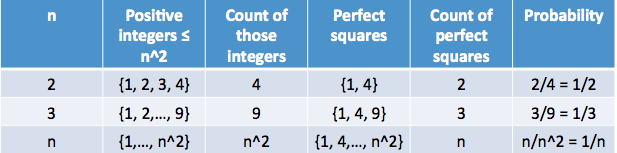
So we are really just adding up 1 + 1/2 + 1/3 + 1/4 + 1/5. We dont need an exact numberwe just need to know what integers that sum falls between. At this point, we might be strategic and grab the middle fractions. 1/2 + 1/3 + 1/4 is just a little more than 1 (since 1/2 + 1/4 + 1/4 would be exactly 1). Adding 1/5 would not get us very far toward 2; this sum would be between 1 and 2. (If we compute 1/2 + 1/3 + 1/4 + 1/5 exactly, we get 30/60 + 20/60 + 15/60 + 12/60 = 77/60, which is definitely between 1 and 2.)
Finally, dont forget to add in [pmath]x_1[/pmath] = 1. Thus, the sum we want (1 + 1/2 + 1/3 + 1/4 + 1/5) is between 2 and 3.
This problem combines several different topicsdivisibility, probability, and fractions. Youll encounter such hybrid problems at the harder end of the GMAT. Not every hard problem is a hybrid, but hybrids tend to be hard, because they force you to solve more than one unrelated problem quickly and correctly.
The correct answer is C.
Special Announcement: If you want to win prizes for answering our Challenge Problems, try entering our Challenge Problem Showdown. Each week, we draw a winner from all the correct answers. The winner receives a number of our our Strategy Guides. The more people enter, the better the prize. Provided the winner gives consent, we will post his or her name on our Facebook page.