BREAKING: Target Test Prep releases Brand New 2026 On Demand GMAT prep course
RedeemHow Do You Know That? Or: The Importance of “Why”
 Todays article is going to be a little bit different from our usual. Rather than picking apart one question or talking about how to review tests or fix weaknesses that is, pretty specific things were going to address a meta topic. When youre doing problems, when youre studying, when youre discussing something with friends or your teacher, whats that one crucial thing that you should be asking yourself?
The answer is in our title: How do you know that? Or, more simply: why?
We spend most of our time and energy figuring out what to do. What calculations are necessary to solve this problem? What grammar rules do I need to apply? What kind of logical thinking do I need to do on this CR problem?
After pretty much every single What question, your next question should be Why? or How do I know that?
Lets say I decide (or, possibly, my book or teacher tells me) that the best way to answer a certain probability question is to use the 1 x shortcut. (This shortcut allows me to calculate the probability for the outcome that I dont want, and then subtract that from 1 to get the probability for the outcome that I do want. Well talk more about this below.)
How do I know that? Lets see oh, its because the question asks for the number of outcomes that will include at least one head. The at least language is a trigger, a clue, that the 1 x shortcut will likely work on that problem.
Why? Why does that work the way it does? Lets say that the problem asked me to flip a fair coin four times (50% chance of landing on heads, 50% chance of landing on tails)and calculate the probability that the outcome will include at least one head.
What are the possible outcomes in general (ignoring probabilities of each)? I could have zero heads (that is, all tails). I could have 1 head. I could have 2 heads, or three heads, or four heads. If I calculated the probabilities of each of those, what would the sum of those probabilities be?
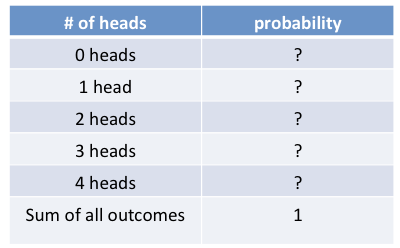
The sum of the probabilities of all of the possible outcomes equals 1. Now, which probabilities do we want and which dont we want?
The question asked us for the outcomes that include at least one head. So we need to include the probabilities for: 1 head, 2 heads, 3 heads, and 4 heads. In fact, theres only one probability category that we dont want: 0 heads. Thats interesting. Call that probability x. What does the 1 x shortcut really mean?
If all of the probabilities add up to one, and if they ask for all of the probabilities except for the all heads outcome, then I can subtract the odd one out from 1 and have my answer! Thats much easier than having to calculate the individual probabilities of each of the outcomes that I do want.
So, when I have a probability question, my trigger that I should think about using the 1 x shortcut is some language about at least or at most that is, something that might be setting me up to have an odd one out situation. Then I just have to check to see whether I really do have an odd one out setup on the problem (and, this being the GMAT, that will be true the vast majority of the time that I see at least or at most language on a probability question).
None of that is about how to do the math its all about WHY this approach works in the first place and HOW I KNOW to use the technique on any particular problem. This is crucially important when studying for standardized tests. If you only study what to do, how will you know when to use all of these great things that youve learned?
What does all of this mean? It means that you need to add two standard questions to your study repertoire: "Why?", and "How do I know that?". When you are studying with someone else (whether a teacher or a fellow student), ask these questions constantly. Whenever someones explaining something to you, dont settle for understanding what the person is telling you (though obviously that is important, too!). Also understand why this problem works the way it does, how you (or your teacher or your fellow student) knew that in the first place, and how you could recognize something similar on another, future problem.
Here are some additional resources that can help you with this process:
Disguising and Decoding Quant Problems an article that talks about how the GMAT disguises things and how to go about figuring out what theyre really trying to tell you.
How to Analyze a Practice Problem a series of questions to ask when reviewing practice problems after youve already tried them
How to Learn From Your Errors first question: why, specifically, did I get this wrong?
Finally, consider taking an index card or piece of paper, writing WHY? on it in big letters, and taping it up in your study area (or just laying it out when you start studying). It seems simple and it is, in one sense but its also very hard to push yourself consistently on this question. If you can train yourself to ask Why? and How do I know that? every step of the way, youll get a lot more out of your GMAT study!