BREAKING: Target Test Prep releases Brand New 2026 On Demand GMAT prep course
RedeemManhattan GMAT Challenge Problem of the Week – 6 Dec 2010
Here is a new Challenge Problem! If you want to win prizes, try entering our Challenge Problem Showdown. The more people enter our challenge, the better the prizes.
Question
In the expansion of [pmath](x + y)^6[/pmath], what is the coefficient of the [pmath]x^3y^3[/pmath] term?(A) 6
(B) 12
(C) 15
(D) 18
(E) 20
Answer
There is a long way to solve this problem, of course: write out (x + y) (x + y) (x + y) (x + y) (x + y) (x + y), expand mechanically, and get the coefficient of the [pmath]x^3y^3[/pmath] term. This would take too long on the GMAT, however.There are at least 2 shortcuts.
1) Start mechanically, but think about what youre doing to make the [pmath]x^3y^3[/pmath] term. You might start with a much simpler case:
[pmath](x + y) (x + y) = x^2 + 2xy + y^2[/pmath]
Notice that you get a 2 on the xy term, because there are two xy products you can form as you expand:
(X + y) (x + Y) you pick the x from the first (x + y) and the y from the second (x + y).
(x + Y) (X + y) vice versa.
If you want to expand a much bigger product of (x + y)s and find the coefficient of a particular term such as [pmath]x^3y^3[/pmath], then you need to think about all the different ways you can get three xs and three ys as you expand.
(X + y) (X + y) (X + y) (x + Y) (x + Y) (x + Y) pick the three xs first, then the three ys.
(X + y) (x + Y) (X + y) (x + Y) (X + y) (x + Y) pick x, y, x, y, x, y. etc.
So really what youre asking is this: how many ways can you rearrange three xs and three ys!Thats a combinatorics problem (how many anagrams are there of the word xxxyyy?). The number of ways to rearrange these letters is 6!/(3!3!) = 20, and 20 is the coefficient on the [pmath]x^3y^3[/pmath] term.
2) Use Pascals Triangle. This is a handy little device to get the coefficients of [pmath](x + y)^n[/pmath], when n is a relatively small integer. You build the triangle downwards with 1s on the outside. All the interior numbers are sums of the two numbers above.
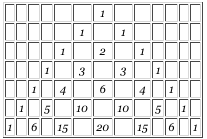
Each row gives you the coefficients of [pmath](x + y)^n[/pmath] for some n. Since the second row gives you 1 and 1 (the coefficients of [pmath](x + y)^1[/pmath] = x + y, its actually the n+1th row that gives you the coefficients of [pmath](x + y)^n[/pmath]. So, for instance, you can just read off the bottom row to get all the coefficients of [pmath](x + y)^6[/pmath]:
[pmath](x + y)^6 = x^6 + 6x^5y + 15x^4y^2 + 20x^3y^3 + 15x^2y^4 + 6xy^5 + y^6[/pmath].
The reason this works is because each number in Pascals triangle represents the number of legal zigzags that get you to that number from the 1 at the top. (A legal zigzag goes down one row and right or left just one number.) For instance, there are 20 legal zigzags that go from the 1 at the top of the triangle to the number 20 in the middle. Each of those zigzags has 3 left zigs and 3 right zags in it. For instance, you could go left-left-left-right-right-right and end up at 20, or you could go left-right-left-right-left-right and end up at 20, etc. This is exactly the same situation as counting the anagrams of a 6-letter word with two repeated letters (x and y, or L and R).
The correct answer is E.
Special Announcement: If you want to win prizes for answering our Challenge Problems, try entering our Challenge Problem Showdown. Each week, we draw a winner from all the correct answers. The winner receives a number of our our Strategy Guides. The more people enter, the better the prize. Provided the winner gives consent, we will post his or her name on our Facebook page.