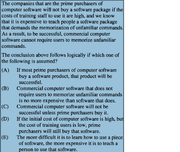
The answer to the question is C
Can anyone let me know how the Options B and C will look like after negating these options.
BREAKING: Target Test Prep releases Brand New 2026 On Demand GMAT prep course
RedeemTarget Test Prep · GMAT
Learn live with an expert or move at your own pace. Every option includes the complete TTP study system.


with Josh Braslow, 20+ years in test prep

Self-paced EA prep. Study on your schedule.

with Logan Thompson
Complete access from day one. Study on your schedule.
Compare the format, schedule, and included access before enrolling. Prices and seat counts shown reflect the supplied offer details.

premise :- prime purchaser will not buy software that require high training cost or require user to learn unfamiliar command.ggmat007 wrote:
The answer to the question is C
Can anyone let me know how the Options B and C will look like after negating these options.
bad idea. those questions are much more formal/rigorous and use far less intuitive/real-world reasoning than the GMAT questions. if you study those materials too much, the likely effect on your score will be negative.ggmat007 wrote:There are enough gmat questions out there but just to ensure that my cr improves by a considerable extent I took on the challenge of solving LSAT questions.
in other words, "Ron, do you really mean what you wrote in that post up there?"Do you really recommend not to solve LSAT questions and concentrate on d ones which are specific to GMAT types?
honestly, you shouldn't even need to do all the RC's in the GMAT official guides; those books alone contain way, way, way more RC's than you should ever have to use. so, the thought of using non-GMAC sources shouldn't even enter the picture, since there's already a huge excess of RC material from GMAC.ggmat007 wrote:Also is it advisable to solve RC questions from LSAT Set
thanks. i suppose i am not up on the latest netspeak.hemant_rajput wrote:He means "the one"; messaging language- d stands for the
good.ggmat007 wrote:Ron first and foremost I am really glad to receive a response from you. Thanks a lot for that. I was little confused with LSAT stuff but now I am going to solely concentrate on GMAT RC and GMAT CR.
i'm not offended by it; i just think it's weird, in this kind of environment (a professional/expert advice board), that's all.Kindly excuse me for the type of language I used in posting my query. I always avoid such habit when I write official emails. Will ensure to carry on the same here as well.




















