Hi, I would like to know if there is better approach to this question instead of solving for equations. Can you please help.
- Attachments
-
BREAKING: Target Test Prep releases Brand New 2026 On Demand GMAT prep course
RedeemTarget Test Prep · GMAT
Learn live with an expert or move at your own pace. Every option includes the complete TTP study system.

with Chris Peckover


with Logan Thompson
Complete access from day one. Study on your schedule.
Compare the format, schedule, and included access before enrolling. Prices and seat counts shown reflect the supplied offer details.


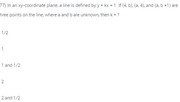
There's a HUGE CLUE in the fact that (a, 4) and (a, b+1) are both on the same line. Notice that the x-coordinates are the same. If the x-coordinates are the same, then there are two possible scenarios:In an xy-coordinate plane, a line is defined by y = kx + 1. If (4, b), (a, 4), and (a, b +1) are three points on the line, where a and b are unknown, then k = ?
a) 1/2
b) 1
c) 1 1/2
d) 2
e) 2 1/2

New here Create free account



















