BTGmoderatorLU wrote:Source: Manhattan GMAT
If x is the reciprocal of a positive integer, then the maximum value of x^y, where y=-x^2, is achieved when x is the reciprocal of
A. 1
B. 2
C. 3
D. 4
E. 5
The OA is B.
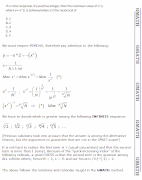
We have to maximize that value of x^y = x^(-x^2) = 1 / x^(x^2)
Say the positive integer is a, thus, x = 1/a
1 / x^(x^2) = 1 / (1/a)^{(1/a)^2} = a^(1/a^2)
So, We have to maximize that value of a^(1/a^2)
Let's try with options:
A. a = 1: a^(1/a^2) = 1^(1/1^2) = 1
B. a = 2: a^(1/a^2) = 2^(1/2^2) = 2^(1/4)
C. a = 3: a^(1/a^2) = 3^(1/3^2) = 3^(1/9)
D. a = 4: a^(1/a^2) = 4^(1/4^2) = 4^(1/16)
E. a = 5: a^(1/a^2) = 5^(1/5^2) = 5^(1/25)
Option A cannot be the correct answer since the values of each of the other options is greater than 1.
For options B through E, for a^(1/a^2), the values of bases (a) increase, while the values of exponents (1/a^2) decrease, thus, it is not straightforward to choose the option that has the maximum value.
We see that for options B through E, for a^(1/a^2), the rate of increase of the bases (a) is relatively lesser than the rate of decrease of the exponents (1/a^2), thus, though because of the increase of values of bases, the values of a^(1/a^2) increase, their values decrease considerably due to the decrease in the values of exponents. Thus, as we move from option B, C, D, and E, the values decrease. Thus, the maximum possible value of a^(1/a^2) is at a = 2.
The correct answer:
B
Hope this helps!
-Jay
_________________
Manhattan Review
Locations:
Manhattan Review Madhapur |
GMAT Prep Kukatpally |
GRE Prep Jayanagar |
Tarnaka GRE Coaching | and many more...
Schedule your free consultation with an experienced GMAT Prep Advisor!
Click here.