GCF and LCM

This topic has expert replies
Master | Next Rank: 500 Posts
Posts: 113
Joined: Wed Dec 07, 2011 7:20 am
Thanked: 3 times

GCF and LCM

by manik11 » Mon Feb 29, 2016 5:02 am
If the greatest common factor of two integers, m and n, is 56 and the least common multiple is 840, what is the sum of the m and n?

(1) m is not divisible by 15.
(2) n is divisible by 15

OA : B

Source : Bellcurves
Source: — Data Sufficiency |

User avatar
GMAT Instructor
Posts: 15539
Joined: Tue May 25, 2010 12:04 pm
Location: New York, NY
Thanked: 13060 times
Followed by:1906 members
GMAT Score:790

by GMATGuruNY » Mon Feb 29, 2016 5:07 am
If the greatest common factor of two integers, m and n, is 56 and the least common multiple is 840, what is the sum of the m and n?

(1) m is not divisible by 15.
(2) n is divisible by 15
The GCF of m and n is composed of all of the prime factors that divide into both m and n.
56 = 2*2*2*7.
Thus, 2*2*2*7 divides into both m and n.

The LCM of m and n is composed of all of the prime factors that divide into only m, into only n, or into both m and n.
840 = 2*2*2*3*5*7.
Since 2*2*2*7 divides into both m and n, 3 and 5 each divide into only m or into only n.

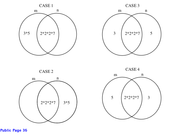
Use Venn Diagrams to organize the data.
The following four cases are possible:
Image

Statement 1: m is not divisible by 15
Here, Cases 2, 3 and 4 are possible.
In Case 2, m = 2*2*2*7 and n= 2*2*2*3*5*7.
In Case 3, m = 2*2*2*3*7 and n = 2*2*2*5*7.
Since the value of m+n will be different in each case, INSUFFICIENT.

Statement 2: n is divisible by 15
Here, only Case 2 is possible.
In Case 2, m = 2*2*2*7 and n= 2*2*2*3*5*7.
Since the value of m+n can be determined, SUFFICIENT.

The correct answer is B.
Private tutor exclusively for the GMAT and GRE, with over 20 years of experience.
Followed here and elsewhere by over 1900 test-takers.
I have worked with students based in the US, Australia, Taiwan, China, Tajikistan, Kuwait, Saudi Arabia -- a long list of countries.
My students have been admitted to HBS, CBS, Tuck, Yale, Stern, Fuqua -- a long list of top programs.

As a tutor, I don't simply teach you how I would approach problems.
I unlock the best way for YOU to solve problems.

For more information, please email me (Mitch Hunt) at [email protected].
Student Review #1
Student Review #2
Student Review #3

User avatar
Legendary Member
Posts: 2663
Joined: Wed Jan 14, 2015 8:25 am
Location: Boston, MA
Thanked: 1153 times
Followed by:128 members
GMAT Score:770

by DavidG@VeritasPrep » Mon Feb 29, 2016 5:12 am
manik11 wrote:If the greatest common factor of two integers, m and n, is 56 and the least common multiple is 840, what is the sum of the m and n?

(1) m is not divisible by 15.
(2) n is divisible by 15

OA : B

Source : Bellcurves
The GCF is 56 = 2^3 * 7. So we know that m and n each contain at least three 2's and one 7.

The LCM is 840 = 2^3 * 3 * 5 * 7 So we know that m or n (but not both) contain one 3 and that m or n (but not both) contain one 7.

S1: Test cases. We know that m does not contain both a 3 and a 5. Given our initial framework, we could have

Case 1: n= 2^3 * 3 * 5 * 7 and m= 2^3 * 7
Case 2 n= 2^3 * 5 * 7 and m= 2^3 * 3 * 7

These two cases will give different sums. S1 is not sufficient.

S2 Now we know for a fact that n contains one 3 and one 5. (And m cannot contain either. Otherwise, the GCF would not be 56.) The only scenario that will satisfy the parameters of the problem is

Case 1: n= 2^3 * 3 * 5 * 7 and m= 2^3 * 7 Because there is only one possible scenario, we can find m + n. Sufficient. Answer is B
Veritas Prep | GMAT Instructor

Veritas Prep Reviews
Save $100 off any live Veritas Prep GMAT Course

GMAT Instructor
Posts: 2630
Joined: Wed Sep 12, 2012 3:32 pm
Location: East Bay all the way
Thanked: 625 times
Followed by:119 members
GMAT Score:780

by Matt@VeritasPrep » Fri Mar 04, 2016 3:52 pm
I have a quick way that might be a little thorny at first, but once you get the idea, I think you'll like it.

Let's start with a great formula that work for any two positive integers x and y:

(GCF of x and y) * (LCM of x and y) = x * y

Applying that to our problem, we have

56 * 840 = m * n

We also know that both m and n are divisible by 56, so we can write both of them as 56*something, where "something" is a positive integer. Let's call these "somethings" a and b, respectively, so we have

m = 56*a
n = 56*b

Now we have

56 * 840 = 56a * 56b

Dividing both sides by 56, we have

840 = a * 56b

Dividing by 56 again, we have

15 = a * b

So we have two possibilities: 3 * 5 or 1 * 15. (In other words, either m = 56*3 and n = 56*5, or m = 56*1 and n = 56*15, or vice versa.) If we can solve for a + b, we're done, since we can easily plug these back into m + n = 56a + 56b. So the question becomes "What's a + b?"

S1::

m is not divisible by 15. So a = 1, 3, or 5. This ISN'T sufficient, since we could have a = 1, b = 15, or a = 3, b = 5, or vice versa, giving us either a + b = 16 or a + b = 8.

S2::

n is divisible by 15. So b must = 15, forcing a = 1, and leaving us with n = 56*15 and m = 56*1. Success!


















