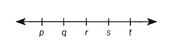
On the number line above, p, q, r, s, and t are five

This topic has expert replies
Moderator
Posts: 7187
Joined: Thu Sep 07, 2017 4:43 pm
Followed by:23 members

Timer

00:00

Your Answer

A

B

C

D

E

Global Stats

Image

On the number line above, p, q, r, s, and t are five consecutive even integers in increasing order. What is the average (arithmetic mean) of these five integers?

(1) q + s =24
(2) The average (arithmetic mean) of q and r is 11.

OA D

Source: Official Guide
Source: — Data Sufficiency |

GMAT/MBA Expert

User avatar
GMAT Instructor
Posts: 3008
Joined: Mon Aug 22, 2016 6:19 am
Location: Grand Central / New York
Thanked: 470 times
Followed by:34 members

by Jay@ManhattanReview » Thu Apr 04, 2019 12:12 am

Timer

00:00

Your Answer

A

B

C

D

E

Global Stats

BTGmoderatorDC wrote:Image

On the number line above, p, q, r, s, and t are five consecutive even integers in increasing order. What is the average (arithmetic mean) of these five integers?

(1) q + s =24
(2) The average (arithmetic mean) of q and r is 11.

OA D

Source: Official Guide

Since p, q, r, s, and t are five consecutive even integers, the average (arithmetic mean) of these five integers would be r.

we have

q = p + 2;
r = p + 4;
s = p + 6;
t = p + 8

So, we have to get the value of p +4.

Let's take each statement one by one.

(1) q + s =24

p + 2 + p + 6 = 24 => 2p + 8 = 24 => p = 8 => r = p + 4 = 8 + 4 = 12. Sufficient.

(2) The average (arithmetic mean) of q and r is 11.

=> [(p + 2) + (p + 4)]/2 = 11 => 2p + 6 = 22 => p = 8 => r = p + 4 = 8 + 4 = 12. Sufficient.

The correct answer: C

Hope this helps!

-Jay
_________________
Manhattan Review LSAT Prep

Locations: Manhattan GMAT | Free GRE Practice Questions | LSAT Prep Courses London | SAT Prep Courses Dubai | and many more...

Schedule your free consultation with an experienced GMAT Prep Advisor! Click here.

Legendary Member
Posts: 2499
Joined: Sun Oct 29, 2017 2:04 pm
Followed by:6 members

by swerve » Thu Apr 04, 2019 10:26 am

Timer

00:00

Your Answer

A

B

C

D

E

Global Stats

Statement 1.
The number of terms is \(5\) so the center term i.e \(r\) will be the average as the series is an arithmetic progression, so it can be found by \(\frac{q +s}{2} = 12\).

Statement 2.
Given \(\frac{q + r}{2} = 11\).

Also \(q = r-2\) (as all are even consecutive integers in a series). So again the average can be found out.

Therefore, the correct answer is __D__