BREAKING: Target Test Prep releases Brand New 2026 On Demand GMAT prep course

Redeem

Target Test Prep · GMAT

Choose how you want to prepare

Learn live with an expert or move at your own pace. Every option includes the complete TTP study system.

★★★★★5.0559 reviews
GMATLiveTeach 7 seats left
Chris Peckover
NEXT LIVE COHORT

Oct 13 to Jan 7, 2027

with Chris Peckover

Schedule
Tue, Thu · 8:00 to 10:00 PM ET
Included
40 live hours + 6 months of GMAT OnDemand
  • Live instruction and real-time questions
  • Class recordings and assigned practice
View class & enroll
Limited cohort · enrollment openTarget Test Prep
EALiveTeach 5 seats left
Logan Thompson
EXECUTIVE ASSESSMENT

Sep 6 to Dec 6, 2026

with Logan Thompson

Schedule
Sun · 9:30 AM to 12:30 PM ET
Included
40 hours of live online classes plus six months of access to the complete TTP EA OnDemand course.
  • 165+ EA Score Guarantee
  • 4,100+ Quant, Verbal, and Integrated Reasoning practice questions
  • 400+ hours of in-depth video lessons
  • 3,000+ step-by-step video solutions
View EA class & enroll
Limited cohort · enrollment openTarget Test Prep
GMATOnDemand Start anytime
SELF-PACED MASTERCLASS

Target Test Prep GMAT OnDemand

Complete access from day one. Study on your schedule.

715+ score guarantee
$0to start then $127/mo
  • Personalized study plan and analytics
  • Thousands of lessons and practice questions

Compare the format, schedule, and included access before enrolling. Prices and seat counts shown reflect the supplied offer details.

Kim and Sue each bought some roses and some

Expert replies
by jjjinapinch » Tue Aug 08, 2017 7:31 am

Timer

00:00

Answers

A

B

C

D

E

Stats

Difficulty

Image

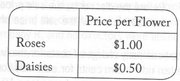
Kim and Sue each bought some roses and some daisies at the prices shown above.If Kim bought the same total number of roses and daisies as Sue,was the price of Kim's purchase of roses and daisies higher than the price of Sue's purchase of roses and daisies?

(1) Kim bought twice as many daisies as roses
(2) Kim bought 4 more roses than Sue bought

Official Guide question
Answer: B
Last edited by jjjinapinch on Wed Aug 09, 2017 11:47 am, edited 1 time in total.
Join the discussion
Source: — Data Sufficiency |

by Ian Stewart » Wed Aug 09, 2017 7:19 am
The table is missing from the post above, but it just says that roses cost $1 each, and daisies cost $0.50 each.

If Kim and Sue buy the same number of flowers in total, the person who spends more will be the person who bought more of the expensive flowers, so we really want to know: did Kim buy more roses than Sue? Statement 1 tells us nothing about how many roses Sue bought, but Statement 2 guarantees that Kim bought more roses than Sue, so the answer is B.
For online GMAT math tutoring, or to buy my higher-level Quant books and problem sets, contact me at ianstewartgmat at gmail.com

ianstewartgmat.com
Join the discussion

by jjjinapinch » Wed Aug 09, 2017 11:47 am
Sorry about that. It's there now.
Join the discussion

by [email protected] » Wed Aug 23, 2017 7:59 pm
Hi jjjinapinch,

We're told that Kim and Sue each bought some roses and some daisies at the prices shown above and that each bought the SAME TOTAL number of flowers. We're asked if the price of Kim's purchase of roses and dailies was higher than the price of Sue's purchase of roses and daisies. This is a YES/NO question. We can solve it by TESTing VALUES and using a bit of logic.

1) Kim bought twice as many daisies as roses

IF....
Kim bought 4 daisies and 2 roses, then she would spend $4.
IF....
Sue bought 4 daisies and 2 roses, then she would spend $4 and the answer to the question is NO.
Sue bought 5 daisies and 1 roses, then she would spend $3.50 and the answer to the question is YES.
Fact 1 is INSUFFICIENT

2) Kim bought 4 more roses than Sue bought

Since Kim bought 4 more roses than Sue, Sue would then end up buying 4 more daisies than Kim (since they both bought the SAME TOTAL number of flowers). Roses cost more than daisies, so Kim would have spent more money than Sue (and the answer to the question is ALWAYS YES.
Fact 2 is SUFFICIENT

Final Answer: B

GMAT assassins aren't born, they're made,
Rich
Contact Rich at [email protected]
Image
Join the discussion

by Scott@TargetTestPrep » Fri Nov 17, 2017 12:56 pm
jjjinapinch wrote:Image

Kim and Sue each bought some roses and some daisies at the prices shown above.If Kim bought the same total number of roses and daisies as Sue,was the price of Kim's purchase of roses and daisies higher than the price of Sue's purchase of roses and daisies?

(1) Kim bought twice as many daisies as roses
(2) Kim bought 4 more roses than Sue bought
Since they bought the same total number of flowers, and roses are more expensive than daisies per flower, the person who purchased more roses spent more money than the other person.
So, the question becomes this: Did Kim purchase more roses than Sue did? If yes, then Kim spent more money than Sue did. If not, then Kim spent less money than Sue did.

Statement One Alone:
Kim bought twice as many daisies as roses.

Even though we know that Kim bought twice as many daisies as roses, we don't know anything about the number of roses and the number of daisies Sue bought. Thus, we can't tell who bought more roses. Statement one alone is not sufficient.

Statement Two Alone:
Kim bought 4 more roses than Sue bought.

Since Kim bought more roses than Sue did, she also spent more money on the flowers than Sue did. Statement two alone is sufficient.

Answer: B

Scott Woodbury-Stewart
Founder and CEO
[email protected]

Image

See why Target Test Prep is rated 5 out of 5 stars on BEAT the GMAT. Read our reviews

ImageImage
Join the discussion



















