Is there a simpler way to solve this question?

This topic has expert replies
Source: — Data Sufficiency |

GMAT/MBA Expert

User avatar
GMAT Instructor
Posts: 16207
Joined: Mon Dec 08, 2008 6:26 pm
Location: Vancouver, BC
Thanked: 5254 times
Followed by:1268 members
GMAT Score:770
[email protected] wrote: Image

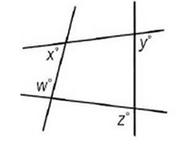
What is the value of x + y in the figure above?
(1) w = 95
(2) z = 125
Target question: What is the value of x + y?
Statement 1: w = 95

Important: For geometry DS questions, we are typically checking to see whether the statements "lock" a particular angle or length into having just one value. This concept is discussed in much greater detail in our free video: https://www.gmatprepnow.com/module/gmat- ... cy?id=1103

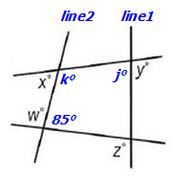
If w = 95, then the angle inside the quadrilateral must be 85.
Image
So, those 2 angles (95 and 85) are "locked." In other words, the 2 lines that create those two angles are locked in place to create the 95- and 85-degree angles.
However, line1 is not locked into place, so we can still move it, which means we can freely alter the size of angle y.
As such, the value of x + y will vary.
Since we cannot answer the target question with certainty, statement 1 is NOT SUFFICIENT

Statement 2: z = 125
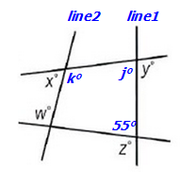
If z = 125, then the angle inside the quadrilateral must be 55.
Image
Since line2 is not locked into place, we can still move it, which means we can freely alter the size of angle x.
As such, the value of x + y will vary.
Since we cannot answer the target question with certainty, statement 2 is NOT SUFFICIENT

Statements 1 and 2 combined:
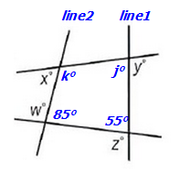
We now have the following:
Image
Since all angles in a quadrilateral add to 360 degrees, we know that 85 + 55 + j + k = 360
If we solve for j + k, we get: j + k = 220

Also notice that, since angles x and k are on a line, it must be true that x + k = 180.
Similarly, it must be true that y + j = 180
If we combine both of these equations, we get: x + y + j + k = 360
Since we already know that j + k = 220, we can replace j + k with 220, to get:
x + y + 220 = 360
This means x + y = 140
Since we can answer the target question with certainty, the combined statements are SUFFICIENT

Answer = C

Cheers,
Brent
Last edited by Brent@GMATPrepNow on Thu Apr 19, 2018 2:08 pm, edited 2 times in total.
Brent Hanneson - Creator of GMATPrepNow.com
Image

Senior | Next Rank: 100 Posts
Posts: 77
Joined: Tue Jul 31, 2012 6:53 am
Thanked: 8 times
Followed by:1 members

by GaneshMalkar » Tue Jun 11, 2013 9:16 am
One more way to do this :-

Let the interior angles be a,b,c,d in the clockwise direction.

Then a+b+c+d = 360 ...(a closed quadrilateral adds angle to 360)

So, (180-x) + (180-y) + (180-w) + (180-z) = 360

720 - (x+y+w+z) = 360
x+y+w+z = 360

x + y = 360 - (w + z) ... We need to know the values of w and z to get x + y

(a) w = 95
Not Sufficient since we need value of z.

(b) z = 125
Not Sufficient since we need value of w.

(a) and (b)

Sufficient.

Answer C
If you cant explain it simply you dont understand it well enough!!!
- Genius

Newbie | Next Rank: 10 Posts
Posts: 9
Joined: Tue Mar 29, 2016 9:13 am

by [email protected] » Fri Apr 01, 2016 10:32 am
Dear All,

Request you to please guide me how can we assume it to be quadrilateral when it is not that the two lines are parallel . As we have learnt in the basic that we should not assume seeing the figure then can we infer that the two lines are parallel.

GMAT/MBA Expert

User avatar
GMAT Instructor
Posts: 16207
Joined: Mon Dec 08, 2008 6:26 pm
Location: Vancouver, BC
Thanked: 5254 times
Followed by:1268 members
GMAT Score:770

by Brent@GMATPrepNow » Fri Apr 01, 2016 10:37 am
[email protected] wrote:Dear All,

Request you to please guide me how can we assume it to be quadrilateral when it is not that the two lines are parallel . As we have learnt in the basic that we should not assume seeing the figure then can we infer that the two lines are parallel.
There need not be any parallel sides for a shape to be a quadrilateral.
A quadrilateral is any 4-sided polygon.

Cheers,
Brent
Brent Hanneson - Creator of GMATPrepNow.com
Image

GMAT/MBA Expert

User avatar
GMAT Instructor
Posts: 2095
Joined: Tue Dec 04, 2012 3:22 pm
Thanked: 1443 times
Followed by:247 members

by ceilidh.erickson » Sat Apr 02, 2016 12:48 pm
GaneshMalkar wrote:One more way to do this :-

Let the interior angles be a,b,c,d in the clockwise direction.

Then a+b+c+d = 360 ...(a closed quadrilateral adds angle to 360)

So, (180-x) + (180-y) + (180-w) + (180-z) = 360

720 - (x+y+w+z) = 360
x+y+w+z = 360

x + y = 360 - (w + z) ... We need to know the values of w and z to get x + y

(a) w = 95
Not Sufficient since we need value of z.

(b) z = 125
Not Sufficient since we need value of w.

(a) and (b)

Sufficient.

Answer C
Ganesh's solution is my recommended approach on this question!

On DS geometry questions, a lot of students get into trouble if they begin by plugging the statement information into the figure right away. If there is a given figure, it's much better to make any and all inferences you can before looking at the statements. Otherwise, you might think that you need statement information that was already inferable from the figure.

Here's an example of a DS geometry problem that student often get wrong if they don't make inferences first:
https://www.beatthegmat.com/area-of-the- ... tml#719010
Ceilidh Erickson
EdM in Mind, Brain, and Education
Harvard Graduate School of Education