Geometry

This topic has expert replies
User avatar
Legendary Member
Posts: 643
Joined: Wed Aug 14, 2013 4:27 am
Thanked: 48 times
Followed by:7 members

Geometry

by vinay1983 » Wed Sep 18, 2013 7:34 am
What is the volume of a certain rectangular solid?

(1) Two adjacent faces of the solid have areas 15 and 24, respectively.
(2) Each of two opposite faces of the solid has area 40.

OA is C

In this question I understand that since we need to find unique value for the volume, we had to do what was supposed to be done.

Instead if the question would have been:

What would have been the third side and the volume of the rectangular solid?

(1) Two adjacent faces of the solid have areas 15 and 24, respectively.
(2) Each of two opposite faces of the solid has area 40.


Then, would A be sufficient?(I hope my intention of asking this question is clear). Would the third side be restricted to a certain value?
You can, for example never foretell what any one man will do, but you can say with precision what an average number will be up to!
Source: — Data Sufficiency |

GMAT/MBA Expert

User avatar
GMAT Instructor
Posts: 16207
Joined: Mon Dec 08, 2008 6:26 pm
Location: Vancouver, BC
Thanked: 5254 times
Followed by:1268 members
GMAT Score:770

by Brent@GMATPrepNow » Wed Sep 18, 2013 8:03 am
vinay1983 wrote:What is the volume of a certain rectangular solid?

(1) Two adjacent faces of the solid have areas 15 and 24, respectively.
(2) Each of two opposite faces of the solid has area 40.
First, here's a full solution to the original question:


Target question: What is the volume of a certain rectangular solid (box)?

Statement 1: Two adjacent faces of the solid have areas 15 and 24, respectively.
There are several different rectangular solids that meet this condition. Here are two:
Case a: the dimensions are 1x15x24, in which case the volume is 360
Case b: the dimensions are 3x5x8, in which case the volume is 120
Since we cannot answer the target question with certainty, statement 1 is NOT SUFFICIENT

Statement 2: Each of two opposite faces of the solid has area 40.
Definitely not sufficient

Statements 1 and 2 combined:
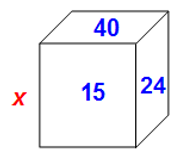
So, we know the area of each face (noted in blue on the diagram below).
Let's let x equal the length of one side.
Image


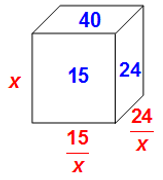
Since the area of each face = (length)(width), we can express the other two dimensions in terms of x.
Image

From here, we'll focus on the face that has area 40.
This face has dimensions (15/x) by (24/x)
Since the area is 40, we know that (15/x)(24/x) = 40
Expand: 360/(x^2) = 40
Simplify: 360 = 40x^2
Simplify: 9 = x^2
Solve: x = 3 or -3
Since the side lengths must be positive, we can be certain that x = 3

When we plug x=3 into the other two dimensions, we get 15/3 and 24/3
So, the 3 dimensions are 3, 5, and 8, which means the volume of the rectangular solid must be 120.
Since we can answer the target question with certainty, the combined statements are SUFFICIENT

Answer = C

Cheers,
Brent
Brent Hanneson - Creator of GMATPrepNow.com
Image

GMAT/MBA Expert

User avatar
GMAT Instructor
Posts: 16207
Joined: Mon Dec 08, 2008 6:26 pm
Location: Vancouver, BC
Thanked: 5254 times
Followed by:1268 members
GMAT Score:770

by Brent@GMATPrepNow » Wed Sep 18, 2013 8:09 am
vinay1983 wrote: Instead if the question would have been:

What would have been the third side and the volume of the rectangular solid?

(1) Two adjacent faces of the solid have areas 15 and 24, respectively.
(2) Each of two opposite faces of the solid has area 40.


Then, would A be sufficient?(I hope my intention of asking this question is clear). Would the third side be restricted to a certain value?
I'm not sure what you mean by the new target question.
If anything it sounds like the new target question is asking for more information than the original target question asked for.

Original target question: What is the volume of the rectangular solid?
Your new target question: What would have been the third side and the volume of the rectangular solid?

If statement 1 did not provide enough information to answer the original target question, it definitely won't provide enough information to answer the new target question (which asks for the volume AND the length of one side)

Or perhaps I've misinterpreted your question(??)

Cheers,
Brent
Brent Hanneson - Creator of GMATPrepNow.com
Image

User avatar
Legendary Member
Posts: 643
Joined: Wed Aug 14, 2013 4:27 am
Thanked: 48 times
Followed by:7 members

by vinay1983 » Wed Sep 18, 2013 6:19 pm
Brent@GMATPrepNow wrote:
vinay1983 wrote: Instead if the question would have been:

What would have been the third side and the volume of the rectangular solid?

(1) Two adjacent faces of the solid have areas 15 and 24, respectively.
(2) Each of two opposite faces of the solid has area 40.


Then, would A be sufficient?(I hope my intention of asking this question is clear). Would the third side be restricted to a certain value?
I'm not sure what you mean by the new target question.
If anything it sounds like the new target question is asking for more information than the original target question asked for.

Original target question: What is the volume of the rectangular solid?
Your new target question: What would have been the third side and the volume of the rectangular solid?

If statement 1 did not provide enough information to answer the original target question, it definitely won't provide enough information to answer the new target question (which asks for the volume AND the length of one side)

Or perhaps I've misinterpreted your question(??)

Cheers,
Brent
Sorry Brent, what i meant to ask was if the 2 area of 2 sides is given as 15 and 24, then we can say:

15=5*3 and 24=8*3, does this imply that the area of the third side should be 8*3(since 15 and 24 are area of 2 adjacent sides and they should share some common side!

Hope I am clear now!
You can, for example never foretell what any one man will do, but you can say with precision what an average number will be up to!