
Melting Problem (Rectangular Solid vs Cube)

This topic has expert replies
Senior | Next Rank: 100 Posts
Posts: 30
Joined: Sun Feb 22, 2009 11:27 pm
GMAT Score:600

Melting Problem (Rectangular Solid vs Cube)

by hijazim » Sun Mar 01, 2009 6:20 am
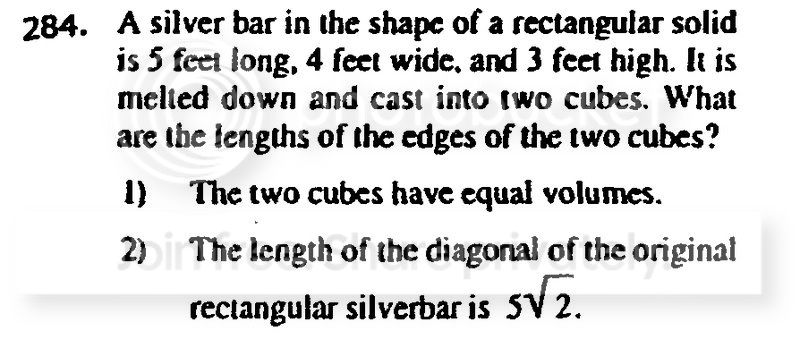
Image

How I interpret it?

stmt 1: You can only assume that volume after melting is reserved which is i am note sure of as i don't remember much from my school physics lectures.
Anyway, assuming this we get:

Volume of cube = volume of rectangular solid / 2 = (5x4x3)/2= 30
and also we can suggest that length of cube 1 = length of cube 2

therefore, L^3=30 => L approximately equals to 3.1 feet

With all this assuming we get that A is sufficient which is the OA.

But about B. Obviously it gives no useful information or am i wrong?

but my concern is that is my interpretation right?? since I did it after I checked the OA, I couldn't get it before as B is so misleading and it widen the scope of the question without need.

Please help.
Source: — Data Sufficiency |

User avatar
Site Admin
Posts: 2567
Joined: Thu Jan 01, 2009 10:05 am
Thanked: 712 times
Followed by:550 members
GMAT Score:770

by DanaJ » Sun Mar 01, 2009 6:28 am
Your interpretation is indeed correct. The second stmt provides no new information, since the diagonal of a rectangular solid is the square root of (length to second power + width to second power + height to second power) or:
d = sqrt(l^3 + w^2 + h^2).
This is why the information provided by the second stmt is smth we can determine from the initial problem: since we have all the lengths of the sides of the rectangular solid, the diagonal will be:
sqrt(5^2 + 4^2 + 3^2) = sqrt(25 + 16 + 9) = sqrt(50) = 5sqrt(2).

Senior | Next Rank: 100 Posts
Posts: 30
Joined: Sun Feb 22, 2009 11:27 pm
GMAT Score:600

by hijazim » Sun Mar 01, 2009 6:59 am
Thanks man I appreciate. It is just nice to be sure :)

















