Answer is either E or C

This topic has expert replies
Legendary Member
Posts: 512
Joined: Mon Jun 18, 2012 11:31 pm
Thanked: 42 times
Followed by:20 members

Answer is either E or C

by sana.noor » Fri Jun 07, 2013 8:20 pm
A manufacturer conducted a survey to determine how many people buy products P and Q. What fraction of the people surveyed said that they neither buy product P nor product Q?
a. 1/3 of the people surveyed said that they buy product P but not product Q.
b. 1/2 of the people surveyed said that they buy product Q.
Work hard in Silence, Let Success make the noise.

If you found my Post really helpful, then don't forget to click the Thank/follow me button. :)
Source: — Data Sufficiency |

User avatar
GMAT Instructor
Posts: 15539
Joined: Tue May 25, 2010 12:04 pm
Location: New York, NY
Thanked: 13060 times
Followed by:1906 members
GMAT Score:790

by GMATGuruNY » Sat Jun 08, 2013 3:20 am
sana.noor wrote:A manufacturer conducted a survey to determine how many people buy products P and Q. What fraction of the people surveyed said that they neither buy product P nor product Q?
a. 1/3 of the people surveyed said that they buy product P but not product Q.
b. 1/2 of the people surveyed said that they buy product Q.
Let T = total, B = both products, and N = neither product.
T = Only P + Only Q + B + N.
Let T = 6.

Neither statement alone is sufficient to solve for N.
Statements combined:
Statement 1 indicates that Only P = (1/3)6 = 2.
Statement 2 indicates that the total number who buy Q = Only Q + B = (1/2)6 = 3.
Plugging these values into the formula in bold, we get:
6 = 2 + 3 + N
N = 1.
Thus:
N/T = 1/6.
SUFFICIENT.

The correct answer is C.
Private tutor exclusively for the GMAT and GRE, with over 20 years of experience.
Followed here and elsewhere by over 1900 test-takers.
I have worked with students based in the US, Australia, Taiwan, China, Tajikistan, Kuwait, Saudi Arabia -- a long list of countries.
My students have been admitted to HBS, CBS, Tuck, Yale, Stern, Fuqua -- a long list of top programs.

As a tutor, I don't simply teach you how I would approach problems.
I unlock the best way for YOU to solve problems.

For more information, please email me (Mitch Hunt) at [email protected].
Student Review #1
Student Review #2
Student Review #3

GMAT/MBA Expert

User avatar
GMAT Instructor
Posts: 16207
Joined: Mon Dec 08, 2008 6:26 pm
Location: Vancouver, BC
Thanked: 5254 times
Followed by:1268 members
GMAT Score:770

by Brent@GMATPrepNow » Sat Jun 08, 2013 6:12 am
sana.noor wrote:A manufacturer conducted a survey to determine how many people buy products P and Q. What fraction of the people surveyed said that they neither buy product P nor product Q?
(1) 1/3 of the people surveyed said that they buy product P but not product Q.
(2) 1/2 of the people surveyed said that they buy product Q.
This is a great candidate for a technique called the Double Matrix Method. It can be used for most questions featuring a population in which each member has two criteria associated with it.
Here, the criteria are:
- buy product Q or not buy product Q
- buy product P or not buy product P
When I scan the two statements I see that they mention 1/3 of the people surveyed and 1/2 of the people surveyed. I also see that the target question asks us to find a fraction of the people surveyed (not the actual number). So, let's pick a nice number that works well with 1/3 and 1/2.
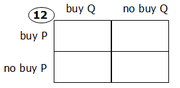
Let's say there 12 people were surveyed.

So, we'll start by setting up our diagram like this:
Image
Aside: To learn more about this technique, watch our free video: https://www.gmatprepnow.com/module/gmat- ... ems?id=919

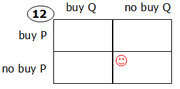
We want to find the fraction of the people surveyed said that they neither buy product P nor product Q. So, to answer this question, we need to know the number of people in the bottom right box (where the happy face is).
Image

We're now ready to check the statements.

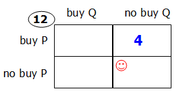
Statement 1: 1/3 of the people surveyed said that they buy product P but not product Q.
1/3 of 12 = 4. So, 4 people buy product P but not product Q.
Image
Does this provide enough information to find the number of people in the bottom right box (where the happy face is)?
No.
Statement 1 is NOT SUFFICIENT

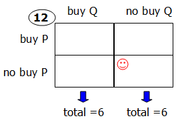
Statement 2: 1/2 of the people surveyed said that they buy product Q.
So, 6 people buy product Q, which means 6 people do not buy product Q
Image
Does this provide enough information to find the number of people in the bottom right box (where the happy face is)?
No.
Statement 2 is NOT SUFFICIENT


Statements 1 and 2 combined:
We get:
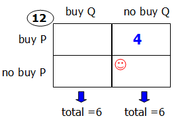
Image
Does this provide enough information to find the number of people in the bottom right box (where the happy face is)?
YES.
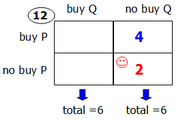
Image
Since the two boxed in the right-hand column must add to 6, the bottom right box must have 2 people, which means 2/12 people said that they neither buy product P nor product Q.

Since we can now answer the target question with certainty, the combined statements are SUFFICIENT

Answer = C

Cheers,
Brent
Brent Hanneson - Creator of GMATPrepNow.com
Image

GMAT/MBA Expert

User avatar
GMAT Instructor
Posts: 16207
Joined: Mon Dec 08, 2008 6:26 pm
Location: Vancouver, BC
Thanked: 5254 times
Followed by:1268 members
GMAT Score:770

by Brent@GMATPrepNow » Sat Jun 08, 2013 6:15 am
Brent Hanneson - Creator of GMATPrepNow.com
Image


















