Hi undefeated (and everyone else following this thread)!
I thought I would start by re-posting the IR prompt in full (both tabs together) so people can try these problems out on their own!
TABS:


QUESTIONS:
#7:

#8:

#9:

Okay, let's take a read and see what we can generally understand from the short paragraph and table. The following are the notes I jotted down from each tab - just something quick to make sure I had a clear understanding of what was offered, and the I could sit back and try to connect the dots...
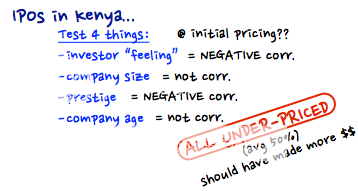
"Kenyan IPO Pricing" Tab
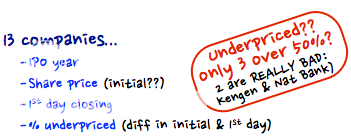
 "Kenyan IPOs, 1994-2008" Tab
 Can I put it together??
Okay, I see a couple of patterns so I just want to make sure I'm clear in my understanding:
- I "hear" that basically all of the Kenyan companies started the bidding WAY too low on their IPOs (an average of 50% too low). But I only "see" (from the table) 3 companies that were over 50% (it is a couple of nasty outliers that are really driving this number).
- I also understand that during this study they tried to figure out if any factors about the companies explained why they set their initial prices where they did. So they assumed that bigger and older firms, with more prestige and with excited investors would start their prices out higher than smaller, newer, less prestigious firms with less excited investors. But that isn't what they found...
...(a) The size and age of the firm was pretty unrelated to initial price
...(b) if investors were MORE interested, the price actually started out LOWER
...(C) if the board was MORE prestigious, the price actually started out LOWER
**NOTE**
It is totally okay that we have spent a bit more time here than on other prompts. Remember that MSR (Multi-Source Reasoning = the ones with the tabs) will typically have 3 questions that accompany it so we should expect to have 7.5 minutes to budget (2.5 min per question).
Now we're ready for the questions!
7A: "IPOs of firms with prestigious boards were more likely to be underpriced than those of other firms."
We know from the reading that IPOs with prestigious boards were more likely to be LOWER-priced than those of other firms, but we do NOT know that they are necessarily UNDER-priced!
NOT Inferable
7B: "Firestone East Africa set its IPO price slightly lower than it should have."
It is clear that Firestone actually set its IPO price TOO HIGH so definitely not slightly LOWER than it should have! Now, make sure you are clear about what it means to be inferable. If something is "inferable" then it can be shown to be TRUE given the information in the passage. We CANNOT show this statement to be true (it is clearly false) so we cannot infer it!
NOT Inferable
7C: "At least one of the firms examined by the researchers did not have an underpriced IPO"
We can actually show that 2 firms (Mumias Sugar & Firestone East Africa) did NOT have underpriced IPOs (the first was priced perfectly with closing prices and the second was overpriced). Therefore we can show that this statement is TRUE based on the information from the passage.
Inferable
8A: "The board of Safaricom was likely considered more prestigious than that of Co-Operative Bank at the time of their IPOs"
What do we know about prestige - well from our notes we know that what the researchers found was that the more prestige, the LOWER the IPO price. Does this match what this question is saying? Safaricom had an IP) of 5 while Co-Operative Bank had a price of 9.50. According to what we read, since Safaricom was cheaper, it was probably considered "more" prestigious.
SUPPORTED
8B: "Kenya Re and Eveready were approximately the same size firms at the time of their IPOs"
What did we read about the size of the firm as it related to the IPO - oh, they were NOT correlated, so we cannot tell anything about trends in firm size from relative IPOs!!
NOT Supported
8C: "When their IPO prices were set, investor sentiment was likely more favorable toward Kengen than toward Scangroup or Eveready"
What did we read about investor sentiment - OH, it was negatively correlated to IPO. So that means the MORE favorable, the LOWER the price. Let's check the table. Kengen was set at 11.90, Scangroup at 10.45 and Eveready at 9.50. This means that Kengen had a HIGHER price than either of the others so would be expected to have a LESS favorable investor sentiment. This is the opposite of what the statement gives.
NOT Supportable
9: "The discussion of the researchers' study of Kenyan IPOs refers to "board prestige" primarily to..."
Well, they talk about it as they try to figure out what causes different companies to set their IPO prices at different amounts. And it was one of the potential "variables" that went in the exact opposite direction of causation compared to what was expected. Check the answer choices...
(A) nope - it doesn't explain anything about sentiment, they were just in a list together
(B) hmmm, maybe but it doesn't say anything about accuracy of the variables
(C) OH, this one looks like what we just summarized
(D) what?? no, this is never related to investor interest (same issue as choice A)
(E) hmmm, now this is talking about the negative correlation to the IPO price, BUT did they mention it to intentionally demonstrate that fact? not really, they seemed to find it "surprising"
That means that we really can trust [spoiler]CHOICE (C)[/spoiler] as the best choice!
SO SUPER long post, but what can we take from it - for MSR problems, take your time doing the following:
(1) Get a clear understanding of ALL tabs, both individually as well as how they connect (the connections are usually where most of the questions will live)
(2) Take a moment to make sure that you clearly understand what the Either/Or questions are asking you to evaluate (what does it mean to be "Inferable" or "Supported")
Hope this helps!

Whit























