BREAKING: Target Test Prep releases Brand New 2026 On Demand GMAT prep course

Redeem

A marketing class of a college

Expert replies
by stevecultt » Tue Jun 20, 2017 10:42 pm
A marketing class of a college has a total strength of 30. It has formed three groups: G1, G2, and G3, which have 10, 10, and 6 students, respectively. If no student of G1 is on either of the other two groups, what is the greatest possible number of students who are on none of the groups?

(A) 6
(B) 7
(C) 8
(D) 10
(E) 14

OA D
Join the discussion
Source: — Problem Solving |

by Jay@ManhattanReview » Tue Jun 20, 2017 11:05 pm
stevecultt wrote:A marketing class of a college has a total strength of 30. It has formed three groups: G1, G2, and G3, which have 10, 10, and 6 students, respectively. If no student of G1 is on either of the other two groups, what is the greatest possible number of students who are on none of the groups?

(A) 6
(B) 7
(C) 8
(D) 10
(E) 14

OA D
Number of students on the committee G1 = 10.

As no member of G1 is on either of the other two groups, the above 10 students belong to only G1.

However, there may be an overlap with the students of G2 and G3.

Number of students on G2 = 10.
Number of students on G3 = 6.

We get the greatest number of students who would not be in any of the groups if there is the maximum overlap between the students of G2 and G3.

So let's assume that all the 6 students in G3 are in G2 group too, thus the minimum number of students in all the groups = 10 + 10 + 6 - 6 = 20.

=> There are 30 - 20 = 10 = Maximum students who are in no groups.

The correct answer: D

Hope this helps!

Download free ebook: Manhattan Review GMAT Quantitative Question Bank Guide

-Jay
_________________
Manhattan Review GMAT Prep

Locations: New York | Vienna | Kuala Lumpur | Sydney | and many more...

Schedule your free consultation with an experienced GMAT Prep Advisor! Click here.
Join the discussion

by GMATGuruNY » Wed Jun 21, 2017 1:56 am
stevecultt wrote:A marketing class of a college has a total strength of 30. It has formed three groups: G1, G2, and G3, which have 10, 10, and 6 students, respectively. If no student of G1 is on either of the other two groups, what is the greatest possible number of students who are on none of the groups?

(A) 6
(B) 7
(C) 8
(D) 10
(E) 14
Of the 30 total students, none of the 10 students in G1 is in G2 or G3.
Thus:
Total number of students in G1, G2 or both = (total number of students) - (students in G1) = 30-10 = 20.

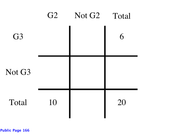
For the remaining 20 students, we can use a DOUBLE-MATRIX.

Total remaining students =20.
Total in G2 = 10.
Total in G3 = 6.
The following matrix is yielded:
Image

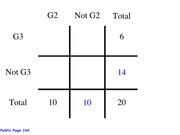
Completing the bottom row and the rightmost column, we get:
Image

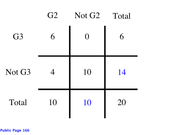
To maximize the number of students in none of the 3 groups, we must maximize the value of the CENTER BOX: the number of students in NEITHER G2 NOR G3.
The value of the center box cannot be greater than the total of the center column (the blue 10) or the total of the middle row (the blue 14 ).
Thus, the greatest possible value for the center box is 10, yielding the following matrix:
Image

As the matrix illustrates, the greatest number of students who can be in neither G2 nor G3 = 10.
Since none of these 10 students is in G1, the greatest number of students who can be in NONE of the three groups = 10.

The correct answer is D.
Private tutor exclusively for the GMAT and GRE, with over 20 years of experience.
Followed here and elsewhere by over 1900 test-takers.
I have worked with students based in the US, Australia, Taiwan, China, Tajikistan, Kuwait, Saudi Arabia -- a long list of countries.
My students have been admitted to HBS, CBS, Tuck, Yale, Stern, Fuqua -- a long list of top programs.

As a tutor, I don't simply teach you how I would approach problems.
I unlock the best way for YOU to solve problems.

For more information, please email me (Mitch Hunt) at [email protected].
Student Review #1
Student Review #2
Student Review #3
Join the discussion

by [email protected] » Wed Jun 21, 2017 2:01 pm
Hi stevecultt,

Both Jay and Mitch have provided great explanations for this question, so I won't rehash any of that here. Instead, I'd like to know the source of this question. I ask because it's poorly worded - and if the original source is presenting GMAT material in this way, then you might want to consider working with material that better matches the design/style of what you'll see on Test Day.

GMAT assassins aren't born, they're made,
Rich
Contact Rich at [email protected]
Image
Join the discussion

by Matt@VeritasPrep » Thu Jun 22, 2017 5:02 pm
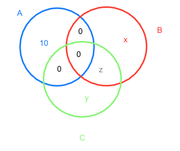
It's easier visually, I think:

Image

We know that x + z = 10 and y + z = 6. To minimize x + y + z, make z (the common element) as large as possible. So if z = 6, y = 0, and x = 4, we've got the minimum.

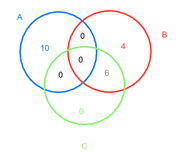
Filling that out, we now have

Image

That gives us 20 people in the three groups, so there are 10 outside.
Join the discussion

by Jeff@TargetTestPrep » Sat Jun 24, 2017 7:03 am
stevecultt wrote:A marketing class of a college has a total strength of 30. It has formed three groups: G1, G2, and G3, which have 10, 10, and 6 students, respectively. If no student of G1 is on either of the other two groups, what is the greatest possible number of students who are on none of the groups?

(A) 6
(B) 7
(C) 8
(D) 10
(E) 14
Since the 10 students in G1 don't belong to either of the other two groups, we can remove them from the total of 30 students. Thus, we have 20 students who belong to G2 and/or G3 and neither of these two groups. We can use the following formula:

20 = #(G2) + #(G3) - #(G2 and G3) + #(neither)

Since we want to maximize #(neither), we want to maximize #(G2 and G3) also. However, #(G2 and G3) is the number of students who belong to both G2 and G3, so it can't be more than the lesser of the number of students in G2 or G3, which is 6. So let's say #(G2 and G3) = 6:

20 = 10 + 6 - 6 + #(neither)

20 = 10 + #(neither)

10 = #(neither)

Since we already excluded the 10 students in G1, not only is #(neither) the number of students in neither G2 nor G3, it's also the number of students in none of the three groups.

Answer: D
Join the discussion