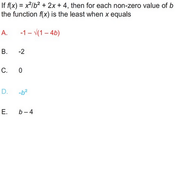
Hmmm, I'm not too sure about this one.
The question suggests that, for each non-zero value of b, the function will
always yields the least possible value when x has a particular value.
So, I chose an easy value for b. I let
b = 1
If
b = 1, then the function becomes
f(x) = x² + 2x + 4
Now let's test each answer choice to see which value of x yields the smallest output.
A) x = -1 - √(1 - 4b)
If
b = 1, then x = -1 - √(1 - 4
(1)) = -1 - √(-3)
Since we can't find the value of √(-3), x has no real value. So, we can't even plug it into f(x)
[on the GMAT, we use real numbers only. In other words, we don't use complex/imaginary numbers]
B) x = -2
f(-2) = (-2)² + 2(-2) + 4 =
4
C) x = 0
f(0) = (0)² + 2(0) + 4 =
4
D) x = -b²
Since we've let
b = 1, we get x = -(
1²) = -1
So, f(-1) = (-1)² + 2(-1) + 4 =
3
E) x = b - 4
Since we've let
b = 1, we get x = (
1) - 4 = -3
So, f(-3) = (-3)² + 2(-3) + 4 =
7
So, when
b = 1, the function outputs the smallest value when x = -b²
So, IT SEEMS that the answer should be
D
HOWEVER, as you mentioned, if we let b = -2, then the function yields an output of
0 when x = -1 - √(1 - 4b) (answer choice A)
and the function yields an output of
0 when x = -b² (answer choice D). So, it looks like A and D are both correct.
So, unless I'm missing something here, I think this question misses the mark. What's the source?
Cheers,
Brent























