Let's take it step by step:
The circumference of the circle + the perimeter of the square = 40
The circumference of the circle = 2*pi*r
The perimeter of the square = 40 - the circumference of the circle = 40 - 2*pi*r
Each side of the square = (40 - 2*pi*r)/4, or 10 - (pi*r)/2
The area of the square = (10 - (pi*r)/2)^2
The area of the two together = (pi*r)^2 + (10 - (pi*r)/2)^2
BREAKING: Target Test Prep releases Brand New 2026 On Demand GMAT prep course
Redeem
Target Test Prep GMAT OnDemand
Scott Woodbury-Stewart’s private virtual classroom — 400 hours of master-class video lessons for the GMAT Focus Edition.
- 715+ score guarantee — highest in the industry (99th percentile)
- 52 chapters · 1,500+ lessons · 4,000+ practice questions
- 400 hours of video · 1,500+ instructor-led HD smartboard lessons
- 300,000+ students accepted to Harvard, Stanford, Wharton, Booth & Sloan & more
- 24/7 live support + weekly Zoom office hours with GMAT instructors
- TTP AI Assist — 24/7 AI-powered virtual tutor for instant help
- 1,200+ flashcards + AI-powered study assistant & daily calendar
- OnDemand, LiveTeach & GMAT Bootcamp formats available
- Also: GRE, SAT Math & Executive Assessment courses
- MBA Admissions Consulting now available
- 🏆 2025 EdTech Breakthrough Award: Test Prep Solution Provider of the Year
- 200,000+ students served
- 5-day free trial — $0 to start, no auto-billing, cancel anytime
★★★★★
5.0
(559 reviews)
130-pt guarantee
$0 to start
then $127/mo
Area of circle and square in terms of r
Source: Beat The GMAT — Problem Solving |
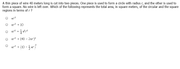
A thin piece of wire 40 meters long is cut into two pieces. One piece is used to form a circle with radius r, and the other is used to form a square. No wire is left over. Which of the following represents the total area, in square meters, of the circular and the square regions in terms of r?
a) (pi)r^2
b) (pi)r^2 + 10
c) (pi)r^2 + (1/4)(pi)^2(r)^2
d) (pi)r^2 + [40 - 2(pi)r]^2
e) (pi)r^2 + [1O - (1/2)(pi)r]^2
Here's an algebraic approach:
Since r is the radius of the circle, the area of the circle will be (pi)r^2.
If r is the radius of the circle, the length of wire used for this circle will equal its circumference which is 2(pi)r
So, the length of wire to be used for the square must equal 40 - 2(pi)r
In other words, the perimeter of the square will be 40 - 2(pi)r
Since squares have 4 equal sides, the length of each side of the square will be [40 - 2(pi)r]/4, which simplifies to be 10 - (pi)r/2
If each side of the square has length 10 - (pi)r/2, the area of the square will be [10 - (pi)r/2]^2
So, the total area will equal (pi)r^2 + [10 - (pi)r/2]^2, which is the same as E
Cheers,
Brent
a) (pi)r^2
b) (pi)r^2 + 10
c) (pi)r^2 + (1/4)(pi)^2(r)^2
d) (pi)r^2 + [40 - 2(pi)r]^2
e) (pi)r^2 + [1O - (1/2)(pi)r]^2
Here's an algebraic approach:
Since r is the radius of the circle, the area of the circle will be (pi)r^2.
If r is the radius of the circle, the length of wire used for this circle will equal its circumference which is 2(pi)r
So, the length of wire to be used for the square must equal 40 - 2(pi)r
In other words, the perimeter of the square will be 40 - 2(pi)r
Since squares have 4 equal sides, the length of each side of the square will be [40 - 2(pi)r]/4, which simplifies to be 10 - (pi)r/2
If each side of the square has length 10 - (pi)r/2, the area of the square will be [10 - (pi)r/2]^2
So, the total area will equal (pi)r^2 + [10 - (pi)r/2]^2, which is the same as E
Cheers,
Brent
Least time consuming approach is as follows...
Assume r = 0, i.e. all the wire is used to make a square.
So, perimeter of the square = 40
So, area of the square = (40/4)² = 10² = 100
So, the correct option must be equal to 100 with r = 0.
One look at the option tells us that only option E works.
Answer : E
Assume r = 0, i.e. all the wire is used to make a square.
So, perimeter of the square = 40
So, area of the square = (40/4)² = 10² = 100
So, the correct option must be equal to 100 with r = 0.
One look at the option tells us that only option E works.
Answer : E
Very nice solution, Atekihcan!Atekihcan wrote:Least time consuming approach is as follows...
Assume r = 0, i.e. all the wire is used to make a square.
So, perimeter of the square = 40
So, area of the square = (40/4)² = 10² = 100
So, the correct option must be equal to 100 with r = 0.
One look at the option tells us that only option E works.
Answer : E
Cheers,
Brent