BREAKING: Target Test Prep releases Brand New 2026 On Demand GMAT prep course

Redeem

Please help with this geometry question

Expert replies
Source: — Data Sufficiency |

by theCodeToGMAT » Sun Mar 09, 2014 6:27 am
[spoiler]{B}[/spoiler]
Attachments
solution.JPG
R A H U L
Join the discussion

by Brent@GMATPrepNow » Sun Mar 09, 2014 7:38 am
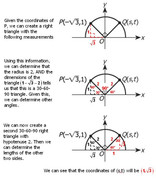
Here's an approach that's similar to Rahuls's (with a couple of extra steps explained):
Image

So, s = 1
Answer: B

Cheers,
Brent
Brent Hanneson - Creator of GMATPrepNow.com
Image
Join the discussion

by Matt@VeritasPrep » Sun Mar 09, 2014 1:12 pm
Neat note on this one: I first saw it on the SAT ... in like 2006! I can't remember which disclosed test it was from, but it was an actual SAT question and it had these exact numbers; I can still remember a student asking me to explain it after he'd just gotten his exam back.

The moral here, as a professor of mine once said, is that the best way to prepare for your exam is to dig up some old ones (SAT, ACT, whatever): math writers love to recycle.
Join the discussion

by QuantVeda » Thu Mar 20, 2014 12:09 am
You can instantly solve this question if you know that when a right angle is rotated then co-ordinates of the one points on circumference is given by interchanging the absolute value of x and y coordinate of other and changing the sign according to quadrant.
Co ordinate of first point -> (-sqrt(3),1)
Interchange the absolute value -> (1, sqrt(3))
Change the sign as per quadrant-> second point lies in first quadrant where x and y coordinates are positive hence coordinate of second point is (1,sqrt(3)).
Accordingly, s=1 and t= sqrt (3)
Join the discussion