i received a private message about this thread.
most of the replies in this thread -- while perfectly correct and respectable solution methods to the problem -- don't really seem to address the original request, which was for guessing hints.
so ...
i hate to say this, but i don't see any "easy guessing hints" here. (even with perfectly symmetric statements, like these, the correct answer could still be any of C/D/E.)
more to the point -- you shouldn't put too much stock in "guessing hints" anyway -- because the entire point of Data Sufficiency, especially at higher levels, is for "gut feelings" to be wrong.
think about the way these things work. for instance, on virtually every mid- or higher-level DS problem on which it seems "obvious" that the answer is C, choice C turns out to be a trap. (in OG12, this happens in problems 105, 107, 108, 117, 123, 136, 144, 149, 150, 154, 168, and 173, among others!)
the best answer i can give here is a non-answer: you should manage time well enough so that you don't end up in this situation in the first place.
see, the mistake that lots of people make here is to think that they should have a "guessing plan", in the same way they'd have an earthquake plan (or other emergency plan).
there's a difference, though: an earthquake (or similar disaster) is something that just happens. it just befalls you; there's nothing you did to cause it, and there's nothing you can do to prevent it from happening. so, in that case, you need a plan.
running out of time on the GMAT, on the other hand, is not something that just happens. it only occurs if you neglect good time management (by sitting there, rather than quickly guessing and moving on, when you get stuck on a problem).
so, although it might be annoying, the best possible answer to this question is, "don't let your time management slip, and then you won't have to worry about this."
the second-best answer is that there's no easy guessing method (remember, that's the whole point); you'll have to try either algebra or plugging, as suggested by the other posters in this thread.
--
also, you said you had 1 minute to solve the problem.
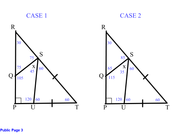
maybe i am missing something here, but, if you already realized that the statements were symmetrical, then 1 minute should definitely have been enough time to try the "plugging" method.
i.e., to tell whether the answer is (d), just test statement 1 or statement 2 alone; you should figure out pretty quickly that neither individual statement is sufficient. boom, not (d).
why didn't you try to do that with the minute that you had?
should have been plenty of time, given what you'd already deduced about the situation in the problem.
(the "visualization" method -- in which you realize that each individual statement still allows you to "wiggle around" one of the segments that make up angle x -- is also, of course, doable within 1 minute. heck, that is doable in a few seconds. but not everyone is going to think of that, especially under pressure.)
Ron has been teaching various standardized tests for 20 years.
--
Pueden hacerle preguntas a Ron en castellano
Potete chiedere domande a Ron in italiano
On peut poser des questions à Ron en français
Voit esittää kysymyksiä Ron:lle myös suomeksi
--
Quand on se sent bien dans un vêtement, tout peut arriver. Un bon vêtement, c'est un passeport pour le bonheur.
Yves Saint-Laurent
--
Learn more about ron