-
BTGmoderatorLU
- Moderator
- Posts: 2505
- Joined: Sun Oct 15, 2017 1:50 pm
- Followed by:6 members
Let's take each statement one by one.BTGmoderatorLU wrote:Source: Economist GMAT
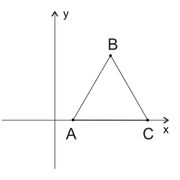
If \(ABC\) is an equilateral triangle, \(AC\) lies on the \(x-\)axis and \(A\) is closer to the origin than \(C\), what are the coordinates of point \(A\)?
1) The coordinates of point \(C\) are \((6,0)\)
2) The coordinates of point \(B\) are \((4, 2\sqrt{3})\)
The OA is B
1) The coordinates of point \(C\) are \((6,0)\).
Can't get the coordinates of point \(A\). Insufficient.
2) The coordinates of point \(B\) are \((4, 2\sqrt{3})\).
Drop a perpendicular from point B on AC. Say it meets AC at Point B'. The perpendicular will divide AC into two equal segments. Say AB' = x; thus, AC = 2x. Also, BB' = 2√3.
In ∆ABB', we have (AB)^2 = (BB')^2 + (AB')^2
Thus, (2x)^2 = (2√3)^2 + x^2 => 4x^2 = 12 + x^2 => 3x^2 = 12 => x = 2.
Thus, the coordinates of point \(A\) are (2, 0). Sufficient.
The correct answer: B
Hope this helps!
-Jay
_________________
Manhattan Review GMAT Prep
Locations: GMAT Classes Atlanta | GMAT Tutoring Philadelphia | GRE Prep Denver | TOEFL Prep Classes San Jose | and many more...
Schedule your free consultation with an experienced GMAT Prep Advisor! Click here.