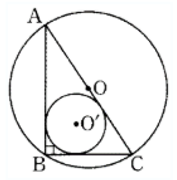
In the figure, ABC is a right triangle. What is the area of

This topic has expert replies
User avatar
Elite Legendary Member
Posts: 3991
Joined: Fri Jul 24, 2015 2:28 am
Location: Las Vegas, USA
Thanked: 19 times
Followed by:37 members

Timer

00:00

Your Answer

A

B

C

D

E

Global Stats

[GMAT math practice question]

In the figure, ABC is a right triangle. What is the area of ABC?

Image

1) Circle O circumscribes triangle ABC and has diameter 13
2) Circle O' is inscribed in triangle ABC and has diameter 6
Source: — Data Sufficiency |

User avatar
Elite Legendary Member
Posts: 3991
Joined: Fri Jul 24, 2015 2:28 am
Location: Las Vegas, USA
Thanked: 19 times
Followed by:37 members

by Max@Math Revolution » Wed Aug 21, 2019 12:11 am

Timer

00:00

Your Answer

A

B

C

D

E

Global Stats

=>

Forget conventional ways of solving math questions. For DS problems, the VA (Variable Approach) method is the quickest and easiest way to find the answer without actually solving the problem. Remember that equal numbers of variables and independent equations ensure a solution.

2 variables are required to specify the two circles, and two variables are required to specify the right triangle. So, we have 4 variables. Since one side of the triangle is equal to the diameter of one of the two circles, we have 1 equation.
Since we have 4 variables and 1 equation, E is most likely to be the answer. So, we should consider conditions 1) & 2) together first. After comparing the number of variables and the number of equations, we can save time by considering conditions 1) & 2) together first.
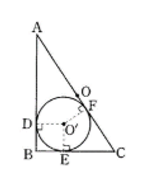
Image

Conditions 1) & 2)
Since the radius of O' is 3, BE = BD = O'E = 3.
Suppose the length of AD is a.
Then AF = AD = a, and CF = CE = 13-a.
So, BC = BE + EC = 3 + 13 - a = 16 - a,
And AB = AD + DB = a + 3.
Thus, the area of triangle ABC is (1/2)(AB+BC+CA)(3) = (1/2)(a+3+16-a+13)(3) = 48

Therefore, C is the answer.
Answer: C

In cases where 3 or more additional equations are required, such as for original conditions with "3 variables", or "4 variables and 1 equation", or "5 variables and 2 equations", conditions 1) and 2) usually supply only one additional equation. Therefore, there is an 80% chance that E is the answer, a 15% chance that C is the answer, and a 5% chance that the answer is A, B or D. Since E (i.e. conditions 1) & 2) are NOT sufficient, when taken together) is most likely to be the answer, it is generally most efficient to begin by checking the sufficiency of conditions 1) and 2), when taken together. Obviously, there may be occasions on which the answer is A, B, C or D.


Legendary Member
Posts: 2214
Joined: Fri Mar 02, 2018 2:22 pm
Followed by:5 members

by deloitte247 » Wed Aug 21, 2019 11:26 am

Timer

00:00

Your Answer

A

B

C

D

E

Global Stats

Question => what is the area of ABC ?
Given that ABC => right angle triangle
Area of ABC = 1/2 * base * height
Base = BC
Height = AB
$$FIND\ \frac{1}{2}\cdot BC\cdot AB=>\frac{BC\cdot AB}{2}$$
Statement 1 => circle 0 circumscribes triangle ABC and has diameter 13
This is making reference to the circle that encapsulates triangle ABC, this will give us AC = 13 but this is not enough to find the value of BC and AB so we cannot find the area of triangle ABC. Hence statement 1 is NOT SUFFICIENT
Statement 2 => circle 0' is inscribed in triangle ABC and has diameter 6
This is making reference to the circle within triangle ABC
Since the diameter of 0' = 6 then radius = 3
Let the radius of 0' from the center of the circle inscribed in the triangle to :
- a point on line AB = 0'D
- a point on line BC = 0'E
- a point on line AC = 0'F
BE = BD = 0'E = 3 but value of BC and AB is still unknown. Hence, statement 2 is NOT SUFFICIENT
Combining both statements together =>
Let line AD = a
Then AF = AD = a and CF = CE = 13 - a
So line BC = BE + EC = 3 + 13 - a = 16 - a
and line AB = AD + DB = a + 3
$$Area=\frac{\left(16-a\right)\left(a+3\right)}{2}=\frac{\left(16a+48-a^2-3a\right)}{2}$$
$$Area=\frac{13a+48-a^2}{2}$$
In conclusion, there is no distinct solution to the value of a; hence, both statement are INSUFFICIENT.

Therefore, the answer is option E.