BREAKING: Target Test Prep releases Brand New 2026 On Demand GMAT prep course

Redeem

Target Test Prep · GMAT

Choose how you want to prepare

Learn live with an expert or move at your own pace. Every option includes the complete TTP study system.

★★★★★5.0559 reviews
GMATLiveTeach 7 seats left
Chris Peckover
NEXT LIVE COHORT

Oct 13 to Jan 7, 2027

with Chris Peckover

Schedule
Tue, Thu · 8:00 to 10:00 PM ET
Included
40 live hours + 6 months of GMAT OnDemand
  • Live instruction and real-time questions
  • Class recordings and assigned practice
View class & enroll
Limited cohort · enrollment openTarget Test Prep
EALiveTeach 5 seats left
Logan Thompson
EXECUTIVE ASSESSMENT

Sep 6 to Dec 6, 2026

with Logan Thompson

Schedule
Sun · 9:30 AM to 12:30 PM ET
Included
40 hours of live online classes plus six months of access to the complete TTP EA OnDemand course.
  • 165+ EA Score Guarantee
  • 4,100+ Quant, Verbal, and Integrated Reasoning practice questions
  • 400+ hours of in-depth video lessons
  • 3,000+ step-by-step video solutions
View EA class & enroll
Limited cohort · enrollment openTarget Test Prep
GMATOnDemand Start anytime
SELF-PACED MASTERCLASS

Target Test Prep GMAT OnDemand

Complete access from day one. Study on your schedule.

715+ score guarantee
$0to start then $127/mo
  • Personalized study plan and analytics
  • Thousands of lessons and practice questions

Compare the format, schedule, and included access before enrolling. Prices and seat counts shown reflect the supplied offer details.

Is there a simpler way to solve this question?

Expert replies
by [email protected] » Tue Jun 11, 2013 3:54 am

Timer

00:00

Answers

A

B

C

D

E

Stats

Difficulty

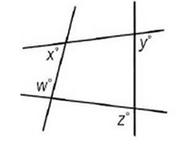
166. What is the value of x + y in the figure above?
(1) w = 95
(2) z = 125
Attachments
11 June.jpg
Join the discussion
Source: — Data Sufficiency |

[email protected] wrote: Image

What is the value of x + y in the figure above?
(1) w = 95
(2) z = 125
Target question: What is the value of x + y?
Statement 1: w = 95

Important: For geometry DS questions, we are typically checking to see whether the statements "lock" a particular angle or length into having just one value. This concept is discussed in much greater detail in our free video: https://www.gmatprepnow.com/module/gmat- ... cy?id=1103

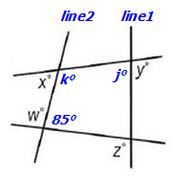
If w = 95, then the angle inside the quadrilateral must be 85.
Image
So, those 2 angles (95 and 85) are "locked." In other words, the 2 lines that create those two angles are locked in place to create the 95- and 85-degree angles.
However, line1 is not locked into place, so we can still move it, which means we can freely alter the size of angle y.
As such, the value of x + y will vary.
Since we cannot answer the target question with certainty, statement 1 is NOT SUFFICIENT

Statement 2: z = 125
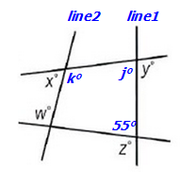
If z = 125, then the angle inside the quadrilateral must be 55.
Image
Since line2 is not locked into place, we can still move it, which means we can freely alter the size of angle x.
As such, the value of x + y will vary.
Since we cannot answer the target question with certainty, statement 2 is NOT SUFFICIENT

Statements 1 and 2 combined:
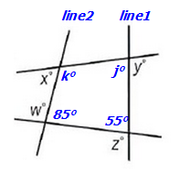
We now have the following:
Image
Since all angles in a quadrilateral add to 360 degrees, we know that 85 + 55 + j + k = 360
If we solve for j + k, we get: j + k = 220

Also notice that, since angles x and k are on a line, it must be true that x + k = 180.
Similarly, it must be true that y + j = 180
If we combine both of these equations, we get: x + y + j + k = 360
Since we already know that j + k = 220, we can replace j + k with 220, to get:
x + y + 220 = 360
This means x + y = 140
Since we can answer the target question with certainty, the combined statements are SUFFICIENT

Answer = C

Cheers,
Brent
Last edited by Brent@GMATPrepNow on Thu Apr 19, 2018 2:08 pm, edited 2 times in total.
Brent Hanneson - Creator of GMATPrepNow.com
Image
Join the discussion

by GaneshMalkar » Tue Jun 11, 2013 9:16 am
One more way to do this :-

Let the interior angles be a,b,c,d in the clockwise direction.

Then a+b+c+d = 360 ...(a closed quadrilateral adds angle to 360)

So, (180-x) + (180-y) + (180-w) + (180-z) = 360

720 - (x+y+w+z) = 360
x+y+w+z = 360

x + y = 360 - (w + z) ... We need to know the values of w and z to get x + y

(a) w = 95
Not Sufficient since we need value of z.

(b) z = 125
Not Sufficient since we need value of w.

(a) and (b)

Sufficient.

Answer C
If you cant explain it simply you dont understand it well enough!!!
- Genius
Join the discussion

by [email protected] » Fri Apr 01, 2016 10:32 am
Dear All,

Request you to please guide me how can we assume it to be quadrilateral when it is not that the two lines are parallel . As we have learnt in the basic that we should not assume seeing the figure then can we infer that the two lines are parallel.
Join the discussion

by Brent@GMATPrepNow » Fri Apr 01, 2016 10:37 am
[email protected] wrote:Dear All,

Request you to please guide me how can we assume it to be quadrilateral when it is not that the two lines are parallel . As we have learnt in the basic that we should not assume seeing the figure then can we infer that the two lines are parallel.
There need not be any parallel sides for a shape to be a quadrilateral.
A quadrilateral is any 4-sided polygon.

Cheers,
Brent
Brent Hanneson - Creator of GMATPrepNow.com
Image
Join the discussion

by ceilidh.erickson » Sat Apr 02, 2016 12:48 pm
GaneshMalkar wrote:One more way to do this :-

Let the interior angles be a,b,c,d in the clockwise direction.

Then a+b+c+d = 360 ...(a closed quadrilateral adds angle to 360)

So, (180-x) + (180-y) + (180-w) + (180-z) = 360

720 - (x+y+w+z) = 360
x+y+w+z = 360

x + y = 360 - (w + z) ... We need to know the values of w and z to get x + y

(a) w = 95
Not Sufficient since we need value of z.

(b) z = 125
Not Sufficient since we need value of w.

(a) and (b)

Sufficient.

Answer C
Ganesh's solution is my recommended approach on this question!

On DS geometry questions, a lot of students get into trouble if they begin by plugging the statement information into the figure right away. If there is a given figure, it's much better to make any and all inferences you can before looking at the statements. Otherwise, you might think that you need statement information that was already inferable from the figure.

Here's an example of a DS geometry problem that student often get wrong if they don't make inferences first:
https://www.beatthegmat.com/area-of-the- ... tml#719010
Ceilidh Erickson
EdM in Mind, Brain, and Education
Harvard Graduate School of Education
Join the discussion