=>
Forget conventional ways of solving math questions. For DS problems, the VA (Variable Approach) method is the quickest and easiest way to find the answer without actually solving the problem. Remember that equal numbers of variables and independent equations ensure a solution.
Visit
https://www.mathrevolution.com/gmat/lesson for details.
The first step of the VA (Variable Approach) method is to modify the original condition and the question. We then recheck the question. We should simplify conditions if necessary.
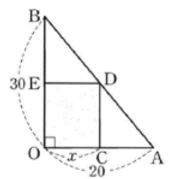
Since the triangle OAB and the triangle CAD are similar, we have OA:OB = 2:3 and CA:CD = 2:3. Then we have 3CA = 2CD or CD = (3/2)(20-x).
So the area of the rectangle OCDE is x*(3/2)(20-x). Therefore, we have one variable in this question.
Since we have 1 variable (x) and 0 equations, D is the most likely answer. So, we should consider each condition separately first.
Condition 1) is sufficient, since it yields a unique solution.
Condition 2)
Since CD = OE = 15 from condition 2), and from the original condition we know CD = (3/2)(20-x).
=>15 = (3/2)(20-x)
=>10 = 20-x
=>x = 10
=>3CA = 2CD
=>3CA = 2(15)
=>3CA = 30
=>CA = 10
We have CA = 10 and x = 10.
So, condition 2) is also sufficient, because it is equivalent to condition 1).
Therefore, D is the answer.
Answer: D
If the original condition includes "1 variable", or "2 variables and 1 equation", or "3 variables and 2 equations" etc., one more equation is required to answer the question. If each of conditions 1) and 2) provide an additional equation, there is a 59% chance that D is the answer, a 38% chance that A or B is the answer, and a 3% chance that the answer is C or E. Thus, answer D (conditions 1) and 2), when applied separately, are sufficient to answer the question) is most likely, but there may be cases where the answer is A,B,C or E.