In the xy-plane, line k passes through the point (1, 1) and line m passes

This topic has expert replies
Legendary Member
Posts: 1223
Joined: Sat Feb 15, 2020 2:23 pm
Followed by:1 members

Timer

00:00

Your Answer

A

B

C

D

E

Global Stats

In the xy-plane, line k passes through the point (1, 1) and line m passes through the point (1, -1). Are the lines k and m perpendicular to each other ?

(1) Lines k and m intersect at the point (1, -1)
(2) Line k intersects the x-axis at the point (1, 0)

Answer: E
Source: GMATPrep test
Source: — Data Sufficiency |

Legendary Member
Posts: 2499
Joined: Sun Oct 29, 2017 2:04 pm
Followed by:6 members

Timer

00:00

Your Answer

A

B

C

D

E

Global Stats

BTGModeratorVI wrote:
Sat Mar 14, 2020 6:53 am
In the xy-plane, line k passes through the point (1, 1) and line m passes through the point (1, -1). Are the lines k and m perpendicular to each other ?

(1) Lines k and m intersect at the point (1, -1)
(2) Line k intersects the x-axis at the point (1, 0)

Answer: E
Source: GMATPrep test
From the question, all we know are points on each k and m. To determine whether the lines are perpendicular, we need to know the slopes of each line.

Statement 1 tells us that \(k\) goes through \((1,1)\) and \((1, -1)\), therefore we can figure out its slope. But we still have no information to determine the slope of line m. Not sufficient

Statement 2 gives us no information that we cannot glean from Statement 1. Not sufficient

Using both Statements, we still cannot determine the slope of line \(m\). Not sufficient

The correct answer is E

Legendary Member
Posts: 2214
Joined: Fri Mar 02, 2018 2:22 pm
Followed by:5 members

Timer

00:00

Your Answer

A

B

C

D

E

Global Stats

- Line k passes through (1, 1)
- Line m passes through (1, -1)
Target question: Are the lines k and m perpendicular to each other?
Note: two lines are said to be perpendicular if the product of their slope is -1
Statement 1 => lines k and m intersect a the point (1, -1), this means the second point of line k (1, -1)
$$Slope\ of\ k=\ \frac{dy}{dx}=\frac{y2-y1}{x2-x1}=\frac{-1-1}{1-1}=undefine$$
But the slope of m is unknown and we cannot determine if the two lines are perpendicular hence target question cannot be answered, therefore, statement 1 is NOT SUFFICIENT

Statement 2=> line k intersects the x-axis at the point (1, 0), this means the second point of line k = (1, 0)
$$Slope\ of\ k=\ \frac{dy}{dx}=\frac{y2-y1}{x2-x1}=\frac{0-1}{1-1}=undefine$$
But slope of m is unknown and we cannot determine if the two lines are perpendicular, hence, target question cannot be answered and statement 2 is NOT SUFFICIENT

Combining both statements together =>
Neither of the two statements gives any information about line m or its slope, So the target question still remains unanswered, hence, both statements together ARE NOT SUFFICIENT
Answer= E


GMAT/MBA Expert

User avatar
GMAT Instructor
Posts: 16207
Joined: Mon Dec 08, 2008 6:26 pm
Location: Vancouver, BC
Thanked: 5254 times
Followed by:1268 members
GMAT Score:770

Timer

00:00

Your Answer

A

B

C

D

E

Global Stats

BTGModeratorVI wrote:
Sat Mar 14, 2020 6:53 am
In the xy-plane, line k passes through the point (1, 1) and line m passes through the point (1, -1). Are the lines k and m perpendicular to each other ?

(1) Lines k and m intersect at the point (1, -1)
(2) Line k intersects the x-axis at the point (1, 0)

Answer: E
Source: GMATPrep test

Target question: Are lines K and m perpendicular to each other?

IMPORTANT: Since line K passes through the point (1, 1), statements 1 and 2 both have the same effect of "locking" line K into exactly one position. In fact, statements 1 and 2 essentially provide the exact same information. As such, it's either the case that each statement is sufficient (D) or each statement is not sufficient (E).

Since neither statement locks line M into any certain position, line M is free to be in lots of different positions, as long as it passes through the point (1, -1)


Okay, let's jump right to . . .
Statements 1 and 2 combined:
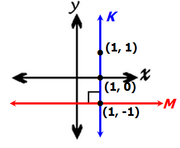
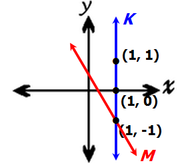
Here are two possible scenarios that satisfy statements 1 and 2.
Scenario a:
Image
In this instance, lines M and K are perpendicular.


Scenario b:
Image
In this instance, lines M and K are not perpendicular.


Since we cannot answer the target question with certainty, the combined statements are NOT SUFFICIENT

Answer = E

Aside: This concept of "locking in" shapes on Geometry DS questions is discussed in much greater detail in our free video: https://www.gmatprepnow.com/module/gmat- ... cy?id=1103

Cheers,
Brent
Brent Hanneson - Creator of GMATPrepNow.com
Image