BREAKING: Target Test Prep releases Brand New 2026 On Demand GMAT prep course

Redeem

Lines k and m are parallel to each other.

Expert replies
by jjjinapinch » Mon Jul 31, 2017 6:36 am

Timer

00:00

Answers

A

B

C

D

E

Stats

Difficulty

Lines k and m are parallel to each other. Is the slope of line k positive?
(1) Line k passes through the point (3, 2).
(2) Line m passes through the point (-3, 2).

Official Guide question
Answer: E
Join the discussion
Source: — Data Sufficiency |

by Brent@GMATPrepNow » Mon Jul 31, 2017 7:23 am
jjjinapinch wrote:Lines k and m are parallel to each other. Is the slope of line k positive?
(1) Line k passes through the point (3, 2).
(2) Line m passes through the point (-3, 2).

Official Guide question
Answer: E
Target question: Is the slope of line k positive?

Given: Lines k and m are parallel to each other.

Let's jump straight to....

Statements 1 and 2 combined
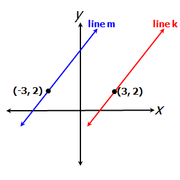
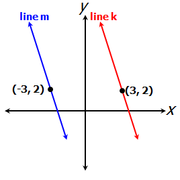
There are many cases that satisfy BOTH statements. Here are two:

Case a:
Image
In this case, the slope of line k is POSITIVE


Case b:

Image
In this case, the slope of line k is NEGATIVE

Since we cannot answer the target question with certainty, the combined statements are NOT SUFFICIENT

Answer: E

Cheers,
Brent
Brent Hanneson - Creator of GMATPrepNow.com
Image
Join the discussion

by Jay@ManhattanReview » Mon Jul 31, 2017 11:28 pm
jjjinapinch wrote:Lines k and m are parallel to each other. Is the slope of line k positive?

(1) Line k passes through the point (3, 2).
(2) Line m passes through the point (-3, 2).

Official Guide question
Answer: E
Nice solution by Brent.

Here's equation approach...

Say the equation of line k is y = mx + c and the equation of line m is y = mx + d;

where m = magnitude of the slope of the lines, and c and d are y-intercepts of lines K and m, respectively.

Since the lines are parallel to each other, their slope, thus magnitude would be equal.

We have to determine whether m is positive.

Statement 1: Line k passes through the point (3, 2).

We have: the equation of line k is y = mx + c;

Thus, 2 = 3m + c. We cannot get the value of m. Insufficient.

Statement 2: Line m passes through the point (-3, 2).

We have: the equation of line m is y = mx + d;

Thus, 2 = -3m + d. We cannot get the value of m. Insufficient.

Statement 1 & 2 combined:

We have 2 = 3m + c and 2 = -3m + d. There are three variables and only two linear equations, we cannot get the value of m. Insufficient.

The correct answer: E

Hope this helps!

Download free ebook: Manhattan Review GMAT Quantitative Question Bank Guide

-Jay
_________________
Manhattan Review GMAT Prep

Locations: New York | Singapore | London | Dubai | and many more...

Schedule your free consultation with an experienced GMAT Prep Advisor! Click here.
Join the discussion

by Jeff@TargetTestPrep » Wed Aug 09, 2017 11:17 am
jjjinapinch wrote:Lines k and m are parallel to each other. Is the slope of line k positive?
(1) Line k passes through the point (3, 2).
(2) Line m passes through the point (-3, 2).

Official Guide question
Answer: E
We are given that lines k and m are parallel to each other, and when two lines are parallel, they have the same slope. We must determine whether the slope of line k is positive.

Statement One Alone:

Line k passes through the point (3, 2).

Using the information in statement one, the slope of line k can be positive or negative. An infinite number of lines can pass through the point (3, 2), some of which have positive slopes and some of which have negative slopes. Statement one alone is not sufficient to answer the question.

Statement Two Alone:

Line m passes through the point (-3, 2).

Using the information in statement two, we know that the slope of line m can be positive or negative. An infinite number of lines can pass through the point (-3, 2), some of which have positive slopes and some of which have negative slopes. Statement two alone is not sufficient to answer the question. We can eliminate answer choice B.

Statements One and Two Together:

Using the information in statements one and two, we know that line k passes through (3, 2) and line m passes through (-3, 2). However, we still do not have enough information to determine whether the slope of line k is positive or negative, since both lines can have positive slopes or both can have negative slopes.
Thus, statements one and two together are not sufficient to answer the question.

Answer: E

Jeffrey Miller
Head of GMAT Instruction
[email protected]

Image

See why Target Test Prep is rated 5 out of 5 stars on BEAT the GMAT. Read our reviews
Join the discussion

by [email protected] » Wed Apr 04, 2018 4:49 pm
Hi All,

We're told that Line K and Line M are PARALLEL to each other (this means that they have the SAME SLOPE). We're asked if the slope of Line K is positive. This is a YES/NO question. You can approach it in a number of different ways, including by drawing a few pictures or as a 'concept question' (meaning that you don't have to actually do any math to solve it as long as you recognize the concepts involved).

1) Line K passes through the point (3, 2).

With just one co-ordinate, the Slope of Line K could be ANY value (positive, negative, 0 or undefined) so the answer could be YES or NO.
Fact 1 is INSUFFICIENT

2) Line M passes through the point (-3, 2).

With just one co-ordinate, the Slope of Line M could be ANY value (positive, negative, 0 or undefined) and since Line K is PARALLEL to Line M, the Slope of Line K could also be ANY value (positive, negative, 0 or undefined) and the answer could be YES or NO.
Fact 2 is INSUFFICIENT

Combined, we still only know one co-ordinate for each line, so there's still no way to determine the exact slope of either line.
Combined, INSUFFICIENT

Final Answer: E

GMAT assassins aren't born, they're made,
Rich
Contact Rich at [email protected]
Image
Join the discussion