What is the area of right triangle XYZ?
(1) Side YZ is 9 inches long.
(2) Side XZ is 15 inches long.
(1) Side YZ is 9 inches long.
(2) Side XZ is 15 inches long.
BREAKING: Target Test Prep releases Brand New 2026 On Demand GMAT prep course
RedeemTarget Test Prep · GMAT
Learn live with an expert or move at your own pace. Every option includes the complete TTP study system.

with Chris Peckover


with Logan Thompson
Complete access from day one. Study on your schedule.
Compare the format, schedule, and included access before enrolling. Prices and seat counts shown reflect the supplied offer details.

Target question: What is the area of right triangle XYZ?ajaysingh24 wrote:What is the area of right triangle XYZ?
(1) Side YZ is 9 inches long.
(2) Side XZ is 15 inches long.

Brent@GMATPrepNow wrote:Target question: What is the area of right triangle XYZ?ajaysingh24 wrote:What is the area of right triangle XYZ?
(1) Side YZ is 9 inches long.
(2) Side XZ is 15 inches long.
KEY CONCEPT: Area of triangle = (1/2)(base)(height)
So, to answer the target question, we need lengths of BOTH the base AND the height.
Statement 1: Side YZ is 9 inches long.
We have only 1 measurement. So, there's no way to determine the area of the triangle.
Since we cannot answer the target question with certainty, statement 1 is NOT SUFFICIENT
Statement 2: Side XZ is 15 inches long.
We have only 1 measurement. So, there's no way to determine the area of the triangle.
Since we cannot answer the target question with certainty, statement 2 is NOT SUFFICIENT
Statements 1 and 2 combined
We still don't have enough information.
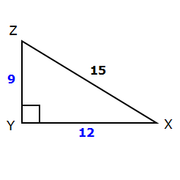
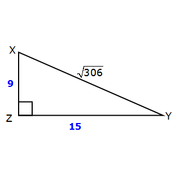
Consider the following 2 cases (which both satisfy the given conditions).
case a:
Here, the area = (1/2)(9)(12) = 54
case b:
Here, the area = (1/2)(9)(15)= 67.5
Since we cannot answer the target question with certainty, the combined statements are NOT SUFFICIENT
Answer = E
Cheers,
Brent
If we know the length of the hypotenuse only, then we can't find the other two lengths.gmattesttaker2 wrote: Hello Brent,
Thanks for the explanation. Suppose we have a right angled triangle where we are given the value of the hypotenuse only and are asked to determine the value of the other two sides, is it possible to determine those values? For example, if the hypotenuse of a right triangle is 5, then I think we can say for sure that the value of the other 2 sides are 3 and 2. Can we do this for any right triangle if we know the hypotenuse? Thanks a lot for your help.
Best Regards,
Sri
I could be wrong but I think I have come across triangles hwere
Brent@GMATPrepNow wrote:If we know the length of the hypotenuse only, then we can't find the other two lengths.gmattesttaker2 wrote: Hello Brent,
Thanks for the explanation. Suppose we have a right angled triangle where we are given the value of the hypotenuse only and are asked to determine the value of the other two sides, is it possible to determine those values? For example, if the hypotenuse of a right triangle is 5, then I think we can say for sure that the value of the other 2 sides are 3 and 2. Can we do this for any right triangle if we know the hypotenuse? Thanks a lot for your help.
Best Regards,
Sri
I could be wrong but I think I have come across triangles hwere
For example, if the hypotenuse has length 5 and the other two sides have lengths x and y, all we can say for certain is that x² + y² = 5² (by the Pythagorean Theorem)
There is an infinite number of solutions to this equation. Here are just a few:
x = 3 and y = 4
x = √11 and y = √14
x = √8 and y = √17
x = 2 and y = √21
etc.
Cheers,
Brent
New here Create free account




















