BREAKING: Target Test Prep releases Brand New 2026 On Demand GMAT prep course

Redeem

Target Test Prep · GMAT

Choose how you want to prepare

Learn live with an expert or move at your own pace. Every option includes the complete TTP study system.

★★★★★5.0559 reviews
GMATBootcamp Starts Sep 21
Chris Peckover, Target Test Prep GMAT expert
LIVE ONLINE BOOTCAMP

Live Online Bootcamp Class with Top GMAT Expert Chris Peckover

Sep 21 to Oct 9, 2026

Schedule
Mon to Fri · 7:00 to 10:00 PM ET
Included
Live classes + 6 months of TTP OnDemand
  • Boost your GMAT score in less than one month in a live online class
  • 6 months access to TTP OnDemand video courses included
View bootcamp & enroll
Limited cohort · enrollment openTarget Test Prep
EALiveTeach 5 seats left
Logan Thompson
EXECUTIVE ASSESSMENT

Sep 6 to Dec 6, 2026

with Logan Thompson

Schedule
Sun · 9:30 AM to 12:30 PM ET
Included
40 hours of live online classes plus six months of access to the complete TTP EA OnDemand course.
  • 165+ EA Score Guarantee
  • 4,100+ Quant, Verbal, and Integrated Reasoning practice questions
  • 400+ hours of in-depth video lessons
  • 3,000+ step-by-step video solutions
View EA class & enroll
Limited cohort · enrollment openTarget Test Prep
GMATOnDemand Start anytime
SELF-PACED MASTERCLASS

Target Test Prep GMAT OnDemand

Complete access from day one. Study on your schedule.

715+ score guarantee
$0to start then $127/mo
  • Personalized study plan and analytics
  • Thousands of lessons and practice questions

Compare the format, schedule, and included access before enrolling. Prices and seat counts shown reflect the supplied offer details.

OH NO Still UNDER 600! Need words of encouragement please!!!

Expert replies
by bond0007 » Sun Apr 24, 2011 7:49 pm
Hi guys, i'm feeling a bit down at this point. I have been studying for the GMAT on-and off for over a year now.. I have not taken a practice test in over a year, and I just took one now (MGMAT) and Scored a 580 (Q35,V34). My last Test over a year ago was a 600 (Q41, V32)

I honestly felt that I was going to get in the Mid 600s this test because I was seeing pretty tough questions, especially on the verbal, where I saw 2 boldfaced ones. However to my great dismay I did EXTREMELY poor in quant, as opposed to last time. The quant was MUCH harder compared to the stuff I did in the OG12, I'm almost certain Manhattan Gmat quant is a lot harder than then OG material.

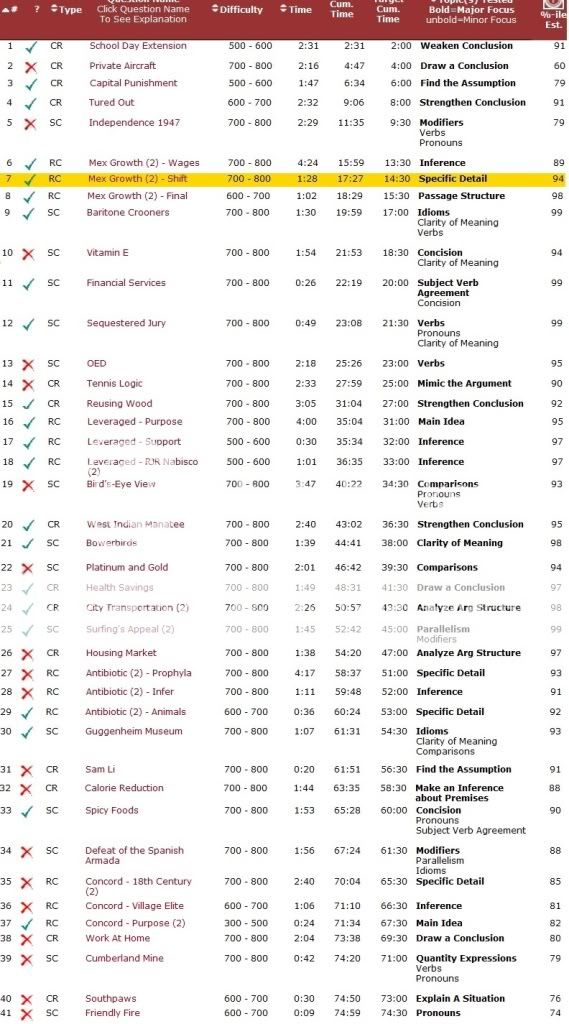
Im including the breakdowns for my test and would love to hear some expert opinions on what I really need to work on. I believe that I can get to 85 Percentile in verbal with a bit more practice and much better time management, since I ran out of time on the last 5 questions. As you can see I was in the 90's for most of the test up until the very end!!

As for the quant, I have gone over the 5 MGMAT books very carefully and took lots of notes. I'm did fairly well on the OG quant questions, yet most of the test questions seemed pretty tricky! I would love to hear your opinions on what I should focus on to get my quant up to the mid 70's percentile!

Thanks again for your time, I would appreciate ANY advice I can get, I really need to get this test over with, it has taken up SO MUCH of my time.


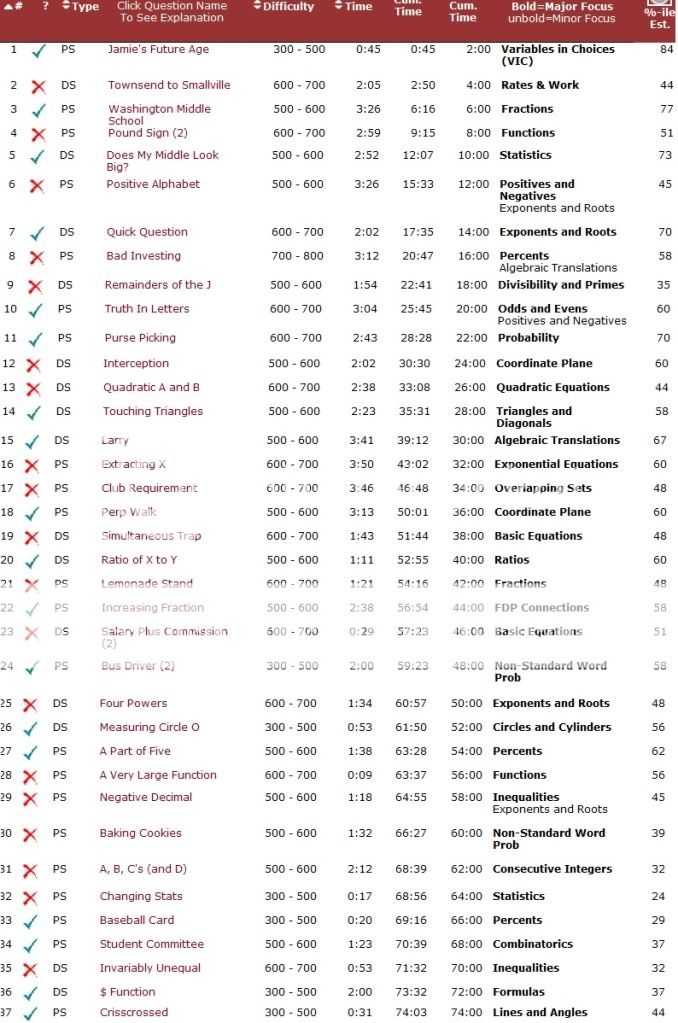
Quant Breakdown here:
https://i1203.photobucket.com/albums/bb3 ... /Quant.jpg


Verbal Breakdown here:
https://i1203.photobucket.com/albums/bb3 ... Verbal.jpg
Join the discussion
Source: — GMAT Strategy |

by bond0007 » Tue Apr 26, 2011 8:05 am
can anyone help please?
Join the discussion

by Brian@VeritasPrep » Tue Apr 26, 2011 9:23 am
Hey Bond,

I'll try to offer a few suggestions:

1) This is just a hunch, but I'm pretty confident in it based on what you wrote:
As for the quant, I have gone over the 5 MGMAT books very carefully and took lots of notes. I'm did fairly well on the OG quant questions, yet most of the test questions seemed pretty tricky!
My theory based on that - you're approaching the GMAT like a high school final exam. You're reading over and taking notes on rules and formulas; you're reviewing the detailed solutions of questions and trying to remember step-by-step how to do them. But your study is focused almost entirely on "remembering" and not on "thinking". The GMAT is not a high school or college final exam - it does not test what you know. It tests how you think - how you apply what you know to solve problems efficiently and logically. Practice test problems should seem tricky - they should usually look like nothing you've seen before, but provide you with one or two anchor points that you know and know well that you can use to get on track.

Like this article (https://www.beatthegmat.com/mba/2011/02/ ... ngineering) notes, the GMAT is big on requiring you to reverse-engineer a concept that you know from top down - you've probably learned how to go from A to Z, but they'll ask you to start in the middle and work your way to either end. If you're focused on "remembering how to do rates/percents/algebra" it's really tough to have that flexibility; if you're thinking in terms of assets ("well, I do know __________ and that allows me to solve for ___________") you're thinking the right way.


2) Your early pacing on the practice test you linked put you in a quick hole...6 of your first 11 questions took you a standard deviation longer than the 2:05 per question average, and while you got 4 of those right it's noticeable that you had to hustle in the back half of the test to compensate. You'll need to develop a pretty good sense within the first 30-45 seconds of looking at a question whether you know you have a path to a correct answer or you just need to make a decent selection and move on. 3 minutes on a wrong answer is a pretty rough use of time; even 3 minutes on a right answer is bittersweet since it's reduced your available time somewhat (I'll still argue that if you know you're on the right track it's probably worth it), but 3 minutes and wrong? That's at least the equivalent of 1.5 wrong answers if not more...you've gotten one wrong and burned half of your time allotment for another question.

With a nod to my first point, I'd recommend that the best way to overcome this is to think more in terms of identifying your assets at the outset - what is the given information and how can you use it to move forward? I'm a big fan of a drill I call "Quick First Step" in which you give yourself 30 or 40 seconds for each of 10 questions and hold yourself accountable for getting started - have something actionable on paper within that initial 30 seconds. Then go back and finish the set. The goal is to train yourself to make use of that initial 30 seconds to either get started quickly or realize that you probably won't be able to get a good foothold and know that it's time to move on.

3) From what I've heard, I think you're right that the Manhattan practice tests are a little harder than the actual test, which I think is a good thing - you're better off practicing on difficult material so that you're ready for anything you might see on test day. So don't let yourself take too much of a confidence hit on this...just use it as a learning experience to identify the kinds of mistakes you're making and the types of questions that are throwing you off.


I hope that's helpful...
Brian Galvin
GMAT Instructor
Chief Academic Officer
Veritas Prep

Looking for GMAT practice questions? Try out the Veritas Prep Question Bank. Learn More.
Join the discussion

by bond0007 » Tue Apr 26, 2011 10:01 am
Brian@VeritasPrep wrote:Hey Bond,

I'll try to offer a few suggestions:

1) This is just a hunch, but I'm pretty confident in it based on what you wrote:
As for the quant, I have gone over the 5 MGMAT books very carefully and took lots of notes. I'm did fairly well on the OG quant questions, yet most of the test questions seemed pretty tricky!
My theory based on that - you're approaching the GMAT like a high school final exam. You're reading over and taking notes on rules and formulas; you're reviewing the detailed solutions of questions and trying to remember step-by-step how to do them. But your study is focused almost entirely on "remembering" and not on "thinking". The GMAT is not a high school or college final exam - it does not test what you know. It tests how you think - how you apply what you know to solve problems efficiently and logically. Practice test problems should seem tricky - they should usually look like nothing you've seen before, but provide you with one or two anchor points that you know and know well that you can use to get on track.

Like this article (https://www.beatthegmat.com/mba/2011/02/ ... ngineering) notes, the GMAT is big on requiring you to reverse-engineer a concept that you know from top down - you've probably learned how to go from A to Z, but they'll ask you to start in the middle and work your way to either end. If you're focused on "remembering how to do rates/percents/algebra" it's really tough to have that flexibility; if you're thinking in terms of assets ("well, I do know __________ and that allows me to solve for ___________") you're thinking the right way.


2) Your early pacing on the practice test you linked put you in a quick hole...6 of your first 11 questions took you a standard deviation longer than the 2:05 per question average, and while you got 4 of those right it's noticeable that you had to hustle in the back half of the test to compensate. You'll need to develop a pretty good sense within the first 30-45 seconds of looking at a question whether you know you have a path to a correct answer or you just need to make a decent selection and move on. 3 minutes on a wrong answer is a pretty rough use of time; even 3 minutes on a right answer is bittersweet since it's reduced your available time somewhat (I'll still argue that if you know you're on the right track it's probably worth it), but 3 minutes and wrong? That's at least the equivalent of 1.5 wrong answers if not more...you've gotten one wrong and burned half of your time allotment for another question.

With a nod to my first point, I'd recommend that the best way to overcome this is to think more in terms of identifying your assets at the outset - what is the given information and how can you use it to move forward? I'm a big fan of a drill I call "Quick First Step" in which you give yourself 30 or 40 seconds for each of 10 questions and hold yourself accountable for getting started - have something actionable on paper within that initial 30 seconds. Then go back and finish the set. The goal is to train yourself to make use of that initial 30 seconds to either get started quickly or realize that you probably won't be able to get a good foothold and know that it's time to move on.

3) From what I've heard, I think you're right that the Manhattan practice tests are a little harder than the actual test, which I think is a good thing - you're better off practicing on difficult material so that you're ready for anything you might see on test day. So don't let yourself take too much of a confidence hit on this...just use it as a learning experience to identify the kinds of mistakes you're making and the types of questions that are throwing you off.


I hope that's helpful...
Thanks a lot for your reply. I definitely need to speed up my timing on the questions that I am not to sure about, so that im not taking away precious time from the ones that i know how to do, but may take me a bit over 2 minutes to solve.
Join the discussion

by bond0007 » Tue Apr 26, 2011 10:52 pm
I just looked over the answers i got wrong on the quant part and tried to solve each one. I ended up getting all but 2 right. So it shows that I do have the knowledge to solve these, but I think i need to take a few seconds to actually figure out my next steps instead of jumping into the problem right away.
Join the discussion