If a certain company purchased computers at $2000 each and printers $300 each, how many computers did it purchase?
We have 2 unknowns in this question. Let:
C = number of computers
P = number of printers
We're given information about the cost of each device, but no information about the total cost, or the total number of devices. To solve for C, we'll need either 2 equations for the 2 variables, or constraints that would narrow things down to a single possibility.
Nb: A single equation may at times be sufficient to solve for 2 variables in a case where there is a POSITIVE INTEGER constraint. For example, if pomegranates cost $5 apiece and mangoes cost $3 apiece and I spend a total of $16, there is only one combination of values that fits: 2 of each. So in cases like these, we don't always need 2 equations for 2 variables. But we do need to be sure that there aren't multiple possible values that would fit. For problems like these, it is often best to use a CHART (see below).
1. More than three printers were purchased.
This gives us no information about computers. Insufficient.
2. The total amount for the purchase of the computers and printers was $15,000.
From this, we can determine that 2000C + 300P = 15,000. (You could simplify algebraically to 20C + 3P = 150). We need to determine if there are multiple possible values for C and P that would fit this total. I like to create a chart for possible values, starting at the highest possible value for C. Then I see if there's a corresponding multiple of 300 that would add to $15,000.
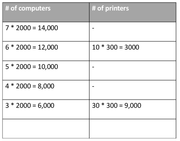
I've found 2 possible values that fit, so this is insufficient.
(1) & (2) together:
There were 2 scenarios from the chart that fit statement 2. Since the number of printer options were 10 or 30, statement 1 doesn't help us to narrow it down. Even with both statements, there are 2 possible sets of values that fit.
The answer is
E.
Ceilidh Erickson
EdM in Mind, Brain, and Education
Harvard Graduate School of Education























