BREAKING: Target Test Prep releases Brand New 2026 On Demand GMAT prep course

Redeem

Is x^3-x>0?

Expert replies
by Max@Math Revolution » Tue Oct 02, 2018 12:26 am

Timer

00:00

Answers

A

B

C

D

E

Stats

Difficulty

[Math Revolution GMAT math practice question]

Is x^3-x>0?

1) x>1.
2) x>0
Join the discussion
Source: — Data Sufficiency |

by GMATGuruNY » Tue Oct 02, 2018 2:53 am
Max@Math Revolution wrote:[Math Revolution GMAT math practice question]

Is x^3-x>0?

1) x>1.
2) x>0
Question stem, rephrased:
Is x³ > x?

Statement 1: x > 1
When a positive value greater than 1 is cubed, the result is greater than the original number:
x=2 --> 2³ > 2
x=3 --> 3³ > 3
x=4 --> 4³ > 4
In every case, x³ > x.
Thus, the answer to the rephrased question stem is YES.
SUFFICIENT.

Statement 2: x > 0
If x=2, then x³ > x, so the answer to the rephrased question stem is YES.
If x=1, then x³ = x, so the answer to the rephrased question stem is NO.
Since the answer is YES in the first case but NO in the second case, INSUFFICIENT.

The correct answer is A.
Private tutor exclusively for the GMAT and GRE, with over 20 years of experience.
Followed here and elsewhere by over 1900 test-takers.
I have worked with students based in the US, Australia, Taiwan, China, Tajikistan, Kuwait, Saudi Arabia -- a long list of countries.
My students have been admitted to HBS, CBS, Tuck, Yale, Stern, Fuqua -- a long list of top programs.

As a tutor, I don't simply teach you how I would approach problems.
I unlock the best way for YOU to solve problems.

For more information, please email me (Mitch Hunt) at [email protected].
Student Review #1
Student Review #2
Student Review #3
Join the discussion

by fskilnik@GMATH » Tue Oct 02, 2018 12:28 pm
Max@Math Revolution wrote:[Math Revolution GMAT math practice question]

Is x^3-x>0?

1) x>1.
2) x>0
$${x^3} - x\,\,\mathop > \limits^? \,\,0\,\,\,\,\, \Leftrightarrow \,\,\,\,\boxed{\,x\left( {{x^2} - 1} \right)\,\,\mathop > \limits^? \,\,0\,}\,$$
$$\left( 1 \right)\,\,x > 1\,\,\,\, \Rightarrow \,\,\,\left\{ \matrix{
x > 0 \hfill \cr
{x^2} > 1\,\,\,\, \Rightarrow \,\,\,{x^2} - 1 > 0 \hfill \cr} \right.\,\,\,\,\,\,\, \Rightarrow \,\,\,\,\,\,\,\left\langle {{\rm{YES}}} \right\rangle $$
$$\left( 2 \right)\,\,\,x > 0\,\,\,\,\left\{ \matrix{
\,{\rm{Take}}\,\,x = 1\,\,\,\, \Rightarrow \,\,\,\left\langle {{\rm{NO}}} \right\rangle \,\, \hfill \cr
\,{\rm{Take}}\,\,x = 2\,\,\,\, \Rightarrow \,\,\,\left\langle {{\rm{YES}}} \right\rangle \,\, \hfill \cr} \right.$$

This solution follows the notations and rationale taught in the GMATH method.

Regards,
Fabio.
Fabio Skilnik :: GMATH method creator ( Math for the GMAT)
English-speakers :: https://www.gmath.net
Portuguese-speakers :: https://www.gmath.com.br
Join the discussion

by Max@Math Revolution » Wed Oct 03, 2018 11:48 pm
=>

Forget conventional ways of solving math questions. For DS problems, the VA (Variable Approach) method is the quickest and easiest way to find the answer without actually solving the problem. Remember that equal numbers of variables and independent equations ensure a solution.

The first step of the VA (Variable Approach) method is to modify the original condition and the question. We then recheck the question.

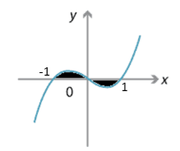
The question x^3-x>0 is equivalent to -1<x<0 or x > 1 as shown below:

x^3-x>0
=> x(x^2-1)>0
=> x(x+1)(x-1) > 0
=> -1<x<0 or x > 1

Image

Since we have 1 variable (x) and 0 equations, D is most likely to be the answer. So, we should consider each of the conditions on their own first.

In inequality questions, the law "Question is King" tells us that if the solution set of the question includes the solution set of the condition, then the condition is sufficient.

Condition 1)
Since the solution set of the question includes that of condition 1), condition 1) is sufficient.

Condition 2)
Since the solution set of the question does not include that of condition 2), condition 2) is not sufficient.


Therefore, A is the answer.
Answer: A

If the original condition includes "1 variable", or "2 variables and 1 equation", or "3 variables and 2 equations" etc., one more equation is required to answer the question. If each of conditions 1) and 2) provide an additional equation, there is a 59% chance that D is the answer, a 38% chance that A or B is the answer, and a 3% chance that the answer is C or E. Thus, answer D (conditions 1) and 2), when applied separately, are sufficient to answer the question) is most likely, but there may be cases where the answer is A,B,C or E.
Join the discussion