BREAKING: Target Test Prep releases Brand New 2026 On Demand GMAT prep course

Redeem

Target Test Prep · GMAT

Choose how you want to prepare

Learn live with an expert or move at your own pace. Every option includes the complete TTP study system.

★★★★★5.0559 reviews
GMATLiveTeach 7 seats left
Chris Peckover
NEXT LIVE COHORT

Oct 13 to Jan 7, 2027

with Chris Peckover

Schedule
Tue, Thu · 8:00 to 10:00 PM ET
Included
40 live hours + 6 months of GMAT OnDemand
  • Live instruction and real-time questions
  • Class recordings and assigned practice
View class & enroll
Limited cohort · enrollment openTarget Test Prep
EALiveTeach 5 seats left
Logan Thompson
EXECUTIVE ASSESSMENT

Sep 6 to Dec 6, 2026

with Logan Thompson

Schedule
Sun · 9:30 AM to 12:30 PM ET
Included
40 hours of live online classes plus six months of access to the complete TTP EA OnDemand course.
  • 165+ EA Score Guarantee
  • 4,100+ Quant, Verbal, and Integrated Reasoning practice questions
  • 400+ hours of in-depth video lessons
  • 3,000+ step-by-step video solutions
View EA class & enroll
Limited cohort · enrollment openTarget Test Prep
GMATOnDemand Start anytime
SELF-PACED MASTERCLASS

Target Test Prep GMAT OnDemand

Complete access from day one. Study on your schedule.

715+ score guarantee
$0to start then $127/mo
  • Personalized study plan and analytics
  • Thousands of lessons and practice questions

Compare the format, schedule, and included access before enrolling. Prices and seat counts shown reflect the supplied offer details.

[Geometry]Manhattan Test question

Expert replies
by Kaustubhk » Wed May 17, 2017 9:17 pm
In the quadrilateral PQRS, side PS is parallel to side QR. Is PQRS a parallelogram?

(1) PS = QR

(2) PQ = RS

What is the answer to this?

According to my analysis it has to be C.

Kindly comment.
Join the discussion
Source: — Data Sufficiency |

by Jay@ManhattanReview » Thu May 18, 2017 11:02 am
Kaustubhk wrote:In the quadrilateral PQRS, side PS is parallel to side QR. Is PQRS a parallelogram?

(1) PS = QR

(2) PQ = RS

What is the answer to this?

According to my analysis it has to be C.

Kindly comment.
Hi Kaustubhk,

The answer is A. Statement 1 alone is sufficient.

If two opposite sides are parallel and equal, the quadrilateral is a parallelogram.

Just to test it yourself. Put two equal sized pencils parallel to each other, and then move one of them keeping it parallel to the other. You would find that the quadrilaterals thus formed are all parallelograms.

The correct answer: A

Hope this helps!

Relevant book: Manhattan Review GMAT Geometry Guide

-Jay
_________________
Manhattan Review GMAT Prep

Locations: New York | Vienna | Kuala Lumpur | Sydney | and many more...

Schedule your free consultation with an experienced GMAT Prep Advisor! Click here.
Join the discussion

by Kaustubhk » Fri May 19, 2017 1:01 am
Thanks Jay..

You are correct. The other set is not required to be parallel and equal. Just one pair of parallel and equal sides is enough.
Join the discussion

by Brent@GMATPrepNow » Fri May 19, 2017 4:55 am
Kaustubhk wrote:In the quadrilateral PQRS, side PS is parallel to side QR. Is PQRS a parallelogram?

(1) PS = QR

(2) PQ = RS
Target question: Is PQRS a parallelogram?

Given: Side PS is parallel to side QR

Statement 1: PS = QR
If side PS is parallel to side QR AND the 2 sides are equal length, then we will definitely get a parallelogram when we join the vertices.
Consider these examples of parallel sides of equal length.
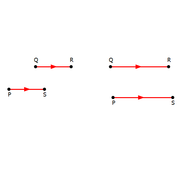
Image


When we connect the vertices, we get parallelograms.
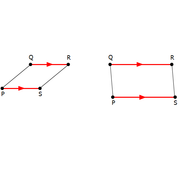
Image

Since we can answer the target question with certainty, statement 1 is SUFFICIENT


Statement 2: PQ = RS
The following two quadrilaterals meet the given conditions:

Quadrilateral 1
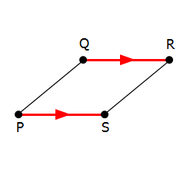
Image
In this case, PQRS IS a parallelogram

Quadrilateral 2
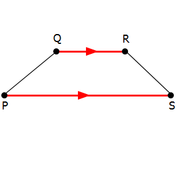
Image
In this case, PQRS is NOT a parallelogram

Since we cannot answer the target question with certainty, statement 2 is NOT SUFFICIENT


Answer: A

Cheers,
Brent
Brent Hanneson - Creator of GMATPrepNow.com
Image
Join the discussion

by Kaustubhk » Fri May 19, 2017 10:57 pm
Hi Brent,

It means that PS|| QR favours the statement A.

The other figures that we get after B are Rhombus and Trapezoid which are Quadrilateral and not parallelogram.

Thanks for the detailed explanation.
Join the discussion

by Brent@GMATPrepNow » Sat May 20, 2017 5:43 am
Kaustubhk wrote:Hi Brent,

It means that PS|| QR favours the statement A.

The other figures that we get after B are Rhombus and Trapezoid which are Quadrilateral and not parallelogram.

Thanks for the detailed explanation.
That's partially correct.
I just want to point out that a rhombus is a type of parallelogram.
Likewise, a square is a type of parallelogram
And a square is a type of rectangle.
etc.

For more on this, watch: https://www.gmatprepnow.com/module/gmat ... /video/874

Cheers,
Brent
Brent Hanneson - Creator of GMATPrepNow.com
Image
Join the discussion


















