PS - Geometry

This topic has expert replies
Source: — Problem Solving |

GMAT/MBA Expert

User avatar
GMAT Instructor
Posts: 16207
Joined: Mon Dec 08, 2008 6:26 pm
Location: Vancouver, BC
Thanked: 5254 times
Followed by:1268 members
GMAT Score:770

by Brent@GMATPrepNow » Mon Jun 23, 2014 12:01 am
Image

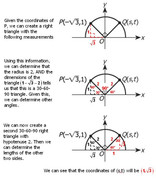
In the figure above, points P and Q lie on the circle with center O. What is the value of S?

a) 1/2
b) 1
c) √2
d) √3
e) (√2)/2
Here's one approach:
Image

So, s = 1
Answer: B

Cheers,
Brent
Brent Hanneson - Creator of GMATPrepNow.com
Image

Master | Next Rank: 500 Posts
Posts: 447
Joined: Fri Nov 08, 2013 7:25 am
Thanked: 25 times
Followed by:1 members

by Mathsbuddy » Mon Jun 23, 2014 6:30 am
If we superimpose the graph on an Argand diagram, by dividing by SQRT(-1) we arrive at co-ordinates that superimpose back to (1, SQRT(3))
Therefore Answer = 1

ONLY GOOD FOR THOSE WHO UNDERSTAND COMPLEX NUMBERS, BUT VERY QUICK TO DO MENTALLY

GMAT/MBA Expert

User avatar
Elite Legendary Member
Posts: 10392
Joined: Sun Jun 23, 2013 6:38 pm
Location: Palo Alto, CA
Thanked: 2867 times
Followed by:511 members
GMAT Score:800

by [email protected] » Mon Jun 23, 2014 11:15 am
Hi kartikc11,

Geometry questions on the GMAT are designed around a limited number of standard formulas and math concepts. You'll become more efficient at solving these types of questions as you learn to spot the patterns involved.

Here, there are a few patterns/rules that immediately come to mind:
1) ANY diagonal line in a graph IS the hypotenuse of a right triangle. You can draw that right triangle by adding the two other sides to the picture. Here, you can draw a line "down" from each point to the X-axis. This will form 2 right triangles.

2) Right triangles on Test day are usually meant to test your knowledge of either the Pythagorean Theorem (A^2 + B^2 = C^2) or your understanding of angles and sides (30/60/90 and 45/45/90).

3) The angles on a line add up to 180 degrees.

4) Circles are always about the radius.

These rules/concepts are what are needed to answer the question (as Brent's explanation shows). During your studies, your ability to spot the rules that apply will help you to work faster and more efficiently.

GMAT assassins aren't born, they're made,
Rich
Contact Rich at [email protected]
Image

User avatar
Legendary Member
Posts: 1100
Joined: Sat May 10, 2014 11:34 pm
Location: New Delhi, India
Thanked: 205 times
Followed by:24 members

by GMATinsight » Mon Jun 23, 2014 8:09 pm
We know that perpendicular lines have relations between slopes as given below:

m1 x m2 = -1

The slope of OP line is 1/√3 = m1

therefore, (-1/√3) x m2 = -1 which means m2 = √3/1

But since OP = OQ (both are redie of the given circle) and OP has actual values in the slope being 1 as y-co ordinate and -√3 as X-co ordinate therefore the values of co-ordinate of OQ also will be actual values

m2 = y coordinate/X coordinate = √3/1 therefore co-ordinates of Q (1, √3) ANSWER

therefore
"GMATinsight"Bhoopendra Singh & Sushma Jha
Most Comprehensive and Affordable Video Course 2000+ CONCEPT Videos and Video Solutions
Whatsapp/Mobile: +91-9999687183 l [email protected]
Contact for One-on-One FREE ONLINE DEMO Class Call/e-mail
Most Efficient and affordable One-On-One Private tutoring fee - US$40-50 per hour