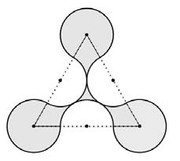
This is a pretty tricky problem.
For now, let's ignore the area of the triangle. If we need to refer to it, we'll call it A.
We'll start by finding the shaded area outside the triangle. We have three circles that have sectors cut out of them from the corners of the triangle. An equilateral triangle has three 60 degree angles. So each circle is missing 60 degrees. A circle is 360 degrees, so each circle is missing 1/6 of its area.
Each side of the triangle is length 2. Each side of the circle accommodates four of the circles' radii, so r = 1/2. Using the area formula of a circle, this gives an area of 1/4Ï€ for each circle. Then since we have 5/6 of each circle and three circles, we have 5/8Ï€ of shaded area outside the triangle.
Since the shaded area inside the triangle is so strangely shaped, lets instead take the area of the triangle and subtract the unshaded area. We have three semicircles, or 3/8Ï€ of unshaded area. So the shaded area inside the triangle is A - 3/8Ï€.
This means, in total, we have 5/8π + (A - 3/8π) = π/4 + A shaded area.
We want to find the difference between the shaded area and the area of the triangle. But we just found that the shaded area is π/4 + A. In other words, there is π/4 more shaded area than area in the triangle, which is answer choice B.
So in the end, we didn't need to solve for the area of the triangle at all. On the GMAT, it's a good idea to see how much math you can avoid doing - usually overly calculation heavy problems (like this one) will have some kind of trick to avoid doing all of that work.