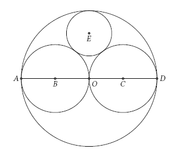
In the figure above, line segment AD is the diameter of

This topic has expert replies
Moderator
Posts: 7187
Joined: Thu Sep 07, 2017 4:43 pm
Followed by:23 members

Timer

00:00

Your Answer

A

B

C

D

E

Global Stats

Image

In the figure above, line segment AD is the diameter of circle O, line segment AO is the diameter of circle B, line segment OD is the diameter of circle C, and circle E is tangent to each of the other circles. If the radius of circle O is 4, what is the radius of circle E?

A. 2/3

B. 3/4

C. 1

D. 4/3

E. 3/2

OA D

Source: Veritas Prep
Source: — Problem Solving |

GMAT/MBA Expert

User avatar
GMAT Instructor
Posts: 3008
Joined: Mon Aug 22, 2016 6:19 am
Location: Grand Central / New York
Thanked: 470 times
Followed by:34 members

by Jay@ManhattanReview » Mon Apr 22, 2019 10:13 pm
BTGmoderatorDC wrote:Image

In the figure above, line segment AD is the diameter of circle O, line segment AO is the diameter of circle B, line segment OD is the diameter of circle C, and circle E is tangent to each of the other circles. If the radius of circle O is 4, what is the radius of circle E?

A. 2/3

B. 3/4

C. 1

D. 4/3

E. 3/2

OA D

Source: Veritas Prep

We have

OA = Radius of circle O = 4; thus, OB = OC = 2

Say the radius of circle E = x

Thus, BE =2 + x

In the ∆EOB, EO is perpendicular to OB, thus, /_EOB = 90º and EO = Radius of circle O - x = 4 - x

Thus, ∆EOB is a right angle triangle. Applying Pythagoras theorem, we have

BE^2 + EO^2 + OB^2

(2 + x)^2 = (4 - x)^2 + 2^2

=> x = 4/3

The correct answer: D

Hope this helps!

-Jay
_________________
Manhattan Review GMAT Prep

Locations: GRE Manhattan | ACT Prep Courses San Diego | IELTS Prep Courses Seattle | Dallas IELTS Tutoring | and many more...

Schedule your free consultation with an experienced GMAT Prep Advisor! Click here.