BREAKING: Target Test Prep releases Brand New 2026 On Demand GMAT prep course

Redeem

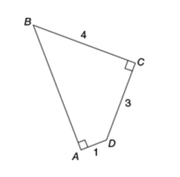
In quadrilateral ABCD above, what is the length of AB ?

Expert replies
by AbeNeedsAnswers » Fri May 03, 2019 6:02 pm

Timer

00:00

Answers

A

B

C

D

E

Stats

Difficulty

Image

In quadrilateral ABCD above, what is the length of AB ?

A) √26
B) 2√5
C) 2√6
D) 3√2
E) 3√3

C

Source: Official Guide 2020
Join the discussion
Source: — Problem Solving |

by Brent@GMATPrepNow » Sat May 04, 2019 6:00 am
AbeNeedsAnswers wrote:Image

In quadrilateral ABCD above, what is the length of AB ?

A) √26
B) 2√5
C) 2√6
D) 3√2
E) 3√3

C

Source: Official Guide 2020
[spoiler=]
2019-04-26_1235.png
[/spoiler][/quote]
First add a line to join B and D:
Image


If we focus on the blue right triangle, we can EITHER recognize that legs of length 3 and 4 are part of the 3-4-5 Pythagorean triplet, OR we can apply the Pythagorean Theorem.
Image
Either way, we'll see that the triangle's hypotenuse (BD) must have length 5

Now, when we focus on the red right triangle, we can . . .
Image
. . . apply the Pythagorean Theorem to write: x² + 1² = 5²
Simplify: x² + 1 = 25
So: x² = 24
So: x = √24 = √[(4)(6)] = (√4)(√6) = 2√6

Answer: C

Cheers,
Brent
Brent Hanneson - Creator of GMATPrepNow.com
Image
Join the discussion

by swerve » Sat May 04, 2019 10:44 am
If we draw diagonal \(BD\), we've created two right triangles: \(BCD\) and \(BAD\). We see that triangle \(BCD\) is a \(3-4-5\) right triangle. So we see that side \(BD = 5\).

Therefore, triangle \(BAD\) is a right triangle with a leg of \(1\) and a hypotenuse of \(5\). We can let side \(AB = n\) and use the Pythagorean theorem to determine \(n\).
$$
\begin{align*}
1^2 + n^2 &= 5^2\\
1 + n^2 &= 25\\
n^2 &= 24\\
n &= \sqrt{24}\\
&= \sqrt{4} \cdot \sqrt{6} \\
&= 2\sqrt{6}
\end{align*}
$$
Join the discussion

by [email protected] » Wed May 22, 2019 8:48 am
Hi All,

We're asked for the length of AB in quadrilateral ABCD.

When dealing with 'weird' shapes, it often helps to break the shape down into 'pieces' that are easier to deal with. Here, if you draw a line from B to D, you will from 2 RIGHT TRIANGLES.

Triangle BCD has legs of 3 and 4, so it's a 3/4/5 right triangle.
Triangle BAD then has a leg of 1 and a hypotenuse of 5. We can use the Pythagorean Formula to find the missing leg...

1^2 + B^2 = 5^2
1 + B^2 = 25
B^2 = 24

From here, if we square-root both sides, we'll have...
B = √24
B = 2√6

Final Answer: C

GMAT assassins aren't born, they're made,
Rich
Contact Rich at [email protected]
Image
Join the discussion