BREAKING: Target Test Prep releases Brand New 2026 On Demand GMAT prep course

Redeem

Target Test Prep · GMAT

Choose how you want to prepare

Learn live with an expert or move at your own pace. Every option includes the complete TTP study system.

★★★★★5.0559 reviews
GMATLiveTeach 7 seats left
Chris Peckover
NEXT LIVE COHORT

Oct 13 to Jan 7, 2027

with Chris Peckover

Schedule
Tue, Thu · 8:00 to 10:00 PM ET
Included
40 live hours + 6 months of GMAT OnDemand
  • Live instruction and real-time questions
  • Class recordings and assigned practice
View class & enroll
Limited cohort · enrollment openTarget Test Prep
EALiveTeach 5 seats left
Logan Thompson
EXECUTIVE ASSESSMENT

Sep 6 to Dec 6, 2026

with Logan Thompson

Schedule
Sun · 9:30 AM to 12:30 PM ET
Included
40 hours of live online classes plus six months of access to the complete TTP EA OnDemand course.
  • 165+ EA Score Guarantee
  • 4,100+ Quant, Verbal, and Integrated Reasoning practice questions
  • 400+ hours of in-depth video lessons
  • 3,000+ step-by-step video solutions
View EA class & enroll
Limited cohort · enrollment openTarget Test Prep
GMATOnDemand Start anytime
SELF-PACED MASTERCLASS

Target Test Prep GMAT OnDemand

Complete access from day one. Study on your schedule.

715+ score guarantee
$0to start then $127/mo
  • Personalized study plan and analytics
  • Thousands of lessons and practice questions

Compare the format, schedule, and included access before enrolling. Prices and seat counts shown reflect the supplied offer details.

If n is a positive integer, is 361 a factor of n?

Expert replies
by hazelnut01 » Mon Mar 27, 2017 5:39 pm
If n is a positive integer, is 361 a factor of n?

1) 76 is the greatest common divisor of 380 and n
2) 5,776 is the least common multiple of 304 and n

Source : Math Revolution
Official answer : B
Join the discussion
Source: — Data Sufficiency |

by ceilidh.erickson » Tue Mar 28, 2017 8:54 am
This question would be extremely difficult to do without a calculator. This is *not* a good example of a GMAT-like question.

For example, I had to reach for a calculator to double-check the factorization of 361: 19*19. With very rare exceptions, the GMAT only expects you to be able to factor so-called "smooth numbers": numbers that can be broken down into small prime factors of 2, 3, 5, and 7 (very occasionally a single factor of 11 or 13, but rarely any primes larger than that).

So, I very seriously doubt that you'd see a question that would ask you to break something down into factors of 19. However, the structure of this question is not atypical of GMAT divisibility problems, so I'll post a solution. (Full disclosure: I did use a calculator here!)

Q: If n is a positive integer, is 361 a factor of n?

A given number will be a factor of another number if all of its component prime factors are factors of that number. In other words, take the prime factorization:
361 = 19*19

Rephrased question: does n have two factors of 19?

1) 76 is the greatest common divisor of 380 and n

First, break down 76:
76 = 2*2*19

If that's a common divisor, that tells us that n must contain at least 2 factors of 2 and one factor of 19. (It also tells us that n does NOT contain a factor of 5. 380 has a factor of 5, so if n also did, then 380 would be the greatest common divisor).

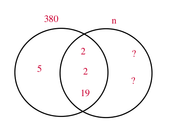
One helpful way to think of the GCD is with a Venn diagram. 380 and n must both contain the component factors of 76, and any other factors that 380 contains, n must NOT contain. We don't know what other factors n might contain that 380 does not:
Image

However, it does not tell us whether n has at least TWO factors of 19. Insufficient.

2) 5,776 is the least common multiple of 304 and n

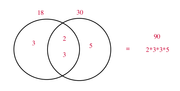
A least common multiple tells us all of the prime factors contained between the two numbers, excluding any overlap. For example, the least common multiple of 18 and 30 is 90:
Image

So to find out what this statement tells us about n, take the prime factorization of both numbers given:
5,776 = 2*2*2*2*19*19
304 = 2*2*2*2*19

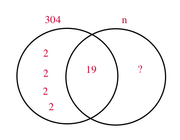
This tells us that between 304 and n, they must together contain all of the prime factors of 5,776. We don't care about the 2's, just the 19's. 5,776 has two factors of 19, and 304 has only one. So n must have at least one. But if it only had one...
Image

That 19 would be an "overlap." Since we need two factors of 19 overall, n itself must have at least two factors of 19. Sufficient.

The answer is B.
Ceilidh Erickson
EdM in Mind, Brain, and Education
Harvard Graduate School of Education
Join the discussion


by hoppycat » Fri Jun 23, 2017 9:59 am
ceilidh.erickson wrote:This question would be extremely difficult to do without a calculator. This is *not* a good example of a GMAT-like question.
thanks for saying that! It took me FOREVER to factor 361!!
Join the discussion

by Jay@ManhattanReview » Sun Jun 25, 2017 11:57 pm
hazelnut01 wrote:If n is a positive integer, is 361 a factor of n?

1) 76 is the greatest common divisor of 380 and n
2) 5,776 is the least common multiple of 304 and n

Source : Math Revolution
Official answer : B
Question: Is 361 a factor of n?

If you remember square till 20, it will click quickly that 361 is a square of 19. So, we have to establish whether n has two 19s in it.

Statement 1: 76 is the greatest common divisor of 380 and n.

Let's factorize 76 and 380.

GCD = 76 = 2^2*19;

380 = 2^2*5*19

Case 1: If n = 2^2*19*k; where k is an integer (k ≠ multiple of 5 and k ≠ multiple of 19^2), GCD is 76. Then answer is No, n does not have two 19s.

Case 2: If n = 2^2*19^2*k; where k is an integer (k ≠ multiple of 5), GCD is still 76. Then answer is Yes, n has two or more 19s.

No unique answer. Insufficient.

Statement 2: 5,776 is the least common multiple of 304 and n.

Let's factorize 5,776 and 304.

LCM = 5776 = 2^4*19^2;

304 = 2^2*19

Since the LCM = 2^4*19^2 and 304 = 2^2*19 provide only one 19, the other 19 would be provided by n. Thus, n must have two 19s.

Sufficient.

The correct answer: B

Hope this helps!

Relevant book: Manhattan Review GMAT Math Essentials Guide

-Jay
_________________
Manhattan Review GMAT Prep

Locations: New York | Singapore | Doha | Lausanne | and many more...

Schedule your free consultation with an experienced GMAT Prep Advisor! Click here.
Join the discussion

by ceilidh.erickson » Mon Jun 26, 2017 7:08 am
You really don't need to memorize 19². Or 18² or 17², for that matter. No OG questions (at least those published in the last 12 years or so - I can't vouch for guides before that, though I assume it would be the same) require that knowledge.

You should know 20², because it's factorable as (2*10)²
Likewise, you can derive these:
16² = 4� = 2�
15² = (3*5)²

If you happen to know all of your squares up to 20², that can be helpful for ballparking. However, if memorizing a lot of facts is difficult for you, know that it is not necessary. You will (almost certainly) never see anything like 19² on the GMAT.
Ceilidh Erickson
EdM in Mind, Brain, and Education
Harvard Graduate School of Education
Join the discussion


















