BREAKING: Target Test Prep releases Brand New 2026 On Demand GMAT prep course

Redeem

Target Test Prep · GMAT

Choose how you want to prepare

Learn live with an expert or move at your own pace. Every option includes the complete TTP study system.

★★★★★5.0559 reviews
GMATBootcamp Starts Sep 21
Chris Peckover, Target Test Prep GMAT expert
LIVE ONLINE BOOTCAMP

Live Online Bootcamp Class with Top GMAT Expert Chris Peckover

Sep 21 to Oct 9, 2026

Schedule
Mon to Fri · 7:00 to 10:00 PM ET
Included
Live classes + 6 months of TTP OnDemand
  • Boost your GMAT score in less than one month in a live online class
  • 6 months access to TTP OnDemand video courses included
View bootcamp & enroll
Limited cohort · enrollment openTarget Test Prep
EALiveTeach 5 seats left
Logan Thompson
EXECUTIVE ASSESSMENT

Sep 6 to Dec 6, 2026

with Logan Thompson

Schedule
Sun · 9:30 AM to 12:30 PM ET
Included
40 hours of live online classes plus six months of access to the complete TTP EA OnDemand course.
  • 165+ EA Score Guarantee
  • 4,100+ Quant, Verbal, and Integrated Reasoning practice questions
  • 400+ hours of in-depth video lessons
  • 3,000+ step-by-step video solutions
View EA class & enroll
Limited cohort · enrollment openTarget Test Prep
GMATOnDemand Start anytime
SELF-PACED MASTERCLASS

Target Test Prep GMAT OnDemand

Complete access from day one. Study on your schedule.

715+ score guarantee
$0to start then $127/mo
  • Personalized study plan and analytics
  • Thousands of lessons and practice questions

Compare the format, schedule, and included access before enrolling. Prices and seat counts shown reflect the supplied offer details.

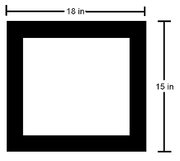
The shaded region in the figure above represents a

Expert replies
by BTGmoderatorLU » Wed Sep 19, 2018 3:35 pm

Timer

00:00

Answers

A

B

C

D

E

Stats

Difficulty

Source: GMAT Prep

Image

The shaded region in the figure above represents a rectangular frame with length 18 inches and width 15 inches. The frame encloses a rectangular picture that has the same area as the frame itself. If the length and width of the picture have the same ratio as the length and width of the frame, what is the length of the picture, in inches?
$$A.\ 9\sqrt{2}$$
$$B.\ \frac{3}{2}$$
$$C.\ \frac{9}{\sqrt{2}}$$
$$D.\ 15\left(1-\frac{1}{\sqrt{2}}\right)$$
$$E.\ \frac{9}{2}$$
The OA is A.
Join the discussion
Source: — Problem Solving |

BTGmoderatorLU wrote:Source: GMAT Prep
Image

The shaded region in the figure above represents a rectangular frame with length 18 inches and width 15 inches. The frame encloses a rectangular picture that has the same area as the frame itself. If the length and width of the picture have the same ratio as the length and width of the frame, what is the length of the picture, in inches?
$$A.\ 9\sqrt{2} \,\,\,\,\,\, B.\ \frac{3}{2} \,\,\,\,\,\, C.\ \frac{9}{\sqrt{2}} \,\,\,\,\,\, D.\ 15\left(1-\frac{1}{\sqrt{2}}\right) \,\,\,\,\,\, E.\ \frac{9}{2}$$
From the question stem ("...the length and width of the picture have the same ratio as the length and width of the frame") we know:
The frame+picture (big rectangle) and the picture (small rectangle) are two SIMILAR rectangles.
(Important: from above we have proportionality on the corresponding sides. The necessary additional condition - equality in the corresponding internal angles - is guaranteed: they are all 90 degrees!)

Again from the question stem we know what the examiner defines as "length" and "width" (by the dimensions associated to these words), so that our FOCUS is:
\[? = x\,\,\,\,\left[ {{\text{inches}}} \right]\,\,\,\,\,\,\left( {{\text{See}}\,\,{\text{figure}}\,\,{\text{below}}} \right)\]
Image

Still from the question stem ("The frame encloses a rectangular picture that has the same area as the frame itself.") we know that the "big" (rectangle) has TWICE the area of the "small" (rectangle).

To avoid using the second dimension of the picture (call it "y" and find another solution using "classical ratios"!), let´s remember an important geometric property:

In any two similar polygons, the ratio of their areas is equal to the square of the ratio of similarity of the polygons!

Therefore:

\[2 = \frac{{{S_{\,{\text{big}}}}}}{{{S_{\,{\text{small}}}}}} = {\left( {\frac{{18}}{x}} \right)^2}\,\,\,\,\mathop \Rightarrow \limits^{x\,\, > \,\,0} \,\,\,\,\,\sqrt 2 = \frac{{18}}{x}\,\,\,\,\,\,\, \Rightarrow \,\,\,\,\,x\sqrt 2 = 18\]
\[x\sqrt 2 = 18\,\,\,\,\,\, \Rightarrow \,\,\,\,\,x\sqrt 2 \cdot \sqrt 2 = 18\sqrt 2 \,\,\,\,\,\, \Rightarrow \,\,\,\,\,? = x = 9\sqrt 2 \]


This solution follows the notations and rationale taught in the GMATH method.

Regards,
Fabio.
Fabio Skilnik :: GMATH method creator ( Math for the GMAT)
English-speakers :: https://www.gmath.net
Portuguese-speakers :: https://www.gmath.com.br
Join the discussion

by Brent@GMATPrepNow » Fri Sep 21, 2018 7:54 am
BTGmoderatorLU wrote:Source: GMAT Prep

Image

The shaded region in the figure above represents a rectangular frame with length 18 inches and width 15 inches. The frame encloses a rectangular picture that has the same area as the frame itself. If the length and width of the picture have the same ratio as the length and width of the frame, what is the length of the picture, in inches?
$$A.\ 9\sqrt{2}$$
$$B.\ \frac{3}{2}$$
$$C.\ \frac{9}{\sqrt{2}}$$
$$D.\ 15\left(1-\frac{1}{\sqrt{2}}\right)$$
$$E.\ \frac{9}{2}$$
The OA is A.
IMPORTANT: the diagrams in GMAT problem solving questions are DRAWN TO SCALE unless stated otherwise.
So, we can use this fact to solve the question by simply "eyeballing" the diagram.

See our video below on this topic as well as other assumptions we can make about diagrams on the GMAT

If you had to ESTIMATE the length of the picture, what would you say it is?
12? 13? 14? 15?

As long as you're in this range, you should be able to solve this one.

ASIDE: On test day, you should have memorized the following approximations:
√2 ≈ 1.4
√3 ≈ 1.7
√5 ≈ 2.2

Now let's check the answer choices....

A. 9√2 ≈ (9)(1.4) ≈ 13. This is within our estimated range. KEEP

B. 3/2 = 1.5. This is WAYYYY outside our estimated range. ELIMINATE

C. 9/√2 ≈ 9/1.4 ≈ 6. This is WAYYYY outside our estimated range. ELIMINATE

D. 15(1 - 1/√2) ≈ 15(1 - 0.7) ≈ (15)(0.3) ≈ 4.5. This is WAYYYY outside our estimated range. ELIMINATE

E. 9/2 = 4.5. This is WAYYYY outside our estimated range. ELIMINATE

Answer: A

RELATED VIDEO FROM OUR COURSE
[you-tube]https://www.youtube.com/watch?v=MaPuJh3m3Pk[/you-tube]
Brent Hanneson - Creator of GMATPrepNow.com
Image
Join the discussion

by Scott@TargetTestPrep » Thu Sep 27, 2018 4:27 pm
BTGmoderatorLU wrote:Source: GMAT Prep

Image

The shaded region in the figure above represents a rectangular frame with length 18 inches and width 15 inches. The frame encloses a rectangular picture that has the same area as the frame itself. If the length and width of the picture have the same ratio as the length and width of the frame, what is the length of the picture, in inches?
$$A.\ 9\sqrt{2}$$
$$B.\ \frac{3}{2}$$
$$C.\ \frac{9}{\sqrt{2}}$$
$$D.\ 15\left(1-\frac{1}{\sqrt{2}}\right)$$
$$E.\ \frac{9}{2}$$
We see that the total area of the frame and the picture is 18 x 15 = 270. Since we know that the length and width of the picture have the same ratio as the length and width of the frame, let's denote the length of the picture by 18k and the width of the picture by 15k, where k is some positive constant.

Then, the area of the picture is (18k)(15k) = 270k^2

The area of the frame can be found by subtracting the area of the picture from the total area of the frame and the picture: 270 - 270k^2

Since the area of the frame is equal to the area of the picture, we have:

270 - 270k^2 = 270k^2

270(1 - k^2) = 270k^2

1 - k^2 = k^2

2k^2 = 1

k^2 = 1/2

k = 1/√2

Since the length of the picture was represented by 18k, the picture's length is 18(1/√2) = 18/√2 = (18/√2)*√2/√2= 18√2/2 = 9√2.

Answer: A

Scott Woodbury-Stewart
Founder and CEO
[email protected]

Image

See why Target Test Prep is rated 5 out of 5 stars on BEAT the GMAT. Read our reviews

ImageImage
Join the discussion



















