BTGmoderatorDC wrote: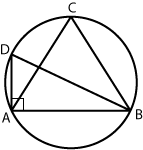
In the figure, ABC is an equilateral triangle, and DAB is a right triangle. What is the area of the circumscribed circle?
(1) DA = 4
(2) Angle ABD = 30 degrees
OA
A
Source: Manhattan Prep
[/quote]
To know the area of the circumscribed circle, we must know its radius.
Let's take each statement one by one.
(1) DA = 4
Note that the arc AB subtends an angle /_ADC and /_ACB on the same side of the circle, thus, both are equal. Now, since ∆ABC is an equilateral triangle, /_ACA = 60º
Thus, /_ADC = 60º. Thus, /_ABD = 90 - 60 = 30º. Thus, ∆ABD is a 90-60-30 right-angled triangle. For a 90-60-30 right-angled triangle, DA : AB : BD :: 1 : √3 : 2. Since we know that DA = 4, we have BD = 2*4 = 8.
Again, since ∆ABC is an equilateral ∆, /_ABC = 60º. We already know that /_ABD = 30º, thus, we conclude that BD bisects /_ABC.
Since ∆ABC is an equilateral triangle, it lies exactly at the center; thus, arc AC = arc BC = arc AB. This implies that BD is a diameter of the circle. Thus, the radius of the circle = BD/2 = 8/2 = 4.
Thus, the area of the circumscribed circle = π*4^2 = 16π. Sufficient.
(2) Angle ABD = 30 degrees
Certainly insufficient.
The correct answer:
A
Hope this helps!
-Jay
_________________
Manhattan Review GMAT Prep
Locations:
GMAT Classes Johannesburg |
GMAT Prep Courses Mumbai |
Manhattan LSAT |
SAT Manhattan Prep Classes | and many more...
Schedule your free consultation with an experienced GMAT Prep Advisor!
Click here.























