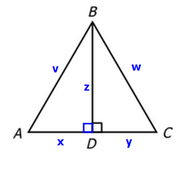
Is triangle ABC an isosceles triangle?
(1) AD = DC
(2) The area of triangle ABD equals the area of triangle BDC
(1) AD = DC
(2) The area of triangle ABD equals the area of triangle BDC
- Attachments
-
BREAKING: Target Test Prep releases Brand New 2026 On Demand GMAT prep course
RedeemTarget Test Prep · GMAT
Learn live with an expert or move at your own pace. Every option includes the complete TTP study system.

with Chris Peckover


with Logan Thompson
Complete access from day one. Study on your schedule.
Compare the format, schedule, and included access before enrolling. Prices and seat counts shown reflect the supplied offer details.

NOTE: I added labels v, w, x, y, and z to make it easier to reference the sides.vittovangind wrote:
Is triangle ABC an isosceles triangle?
(1) AD = DC
(2) The area of triangle ABD equals the area of triangle BDC

Brent@GMATPrepNow wrote:NOTE: I added labels v, w, x, y, and z to make it easier to reference the sides.vittovangind wrote:
Is triangle ABC an isosceles triangle?
(1) AD = DC
(2) The area of triangle ABD equals the area of triangle BDC
Target question: Is triangle ABC an isosceles triangle?
To show that triangle ABC is an isosceles triangle, we can either show that the triangle has two equal angles or two equal sides.
Statement 1: AD = DC (i.e., x = y)
There's a nice rule that says that the altitude of an isosceles triangle always bisects the opposite side. Since the altitude (z) bisects AC, we can conclude that triangle ABC is an isosceles triangle.
Since we can answer the target question with certainty, statement 1 is SUFFICIENT
Here's another way to show that statement 1 is sufficient.
Notice that the two smaller triangles that comprise triangle ABC are both RIGHT TRIANGLES.
The two triangles both SHARE SIDE z, and statement 1 tells us that side x = side y.
Since both smaller triangles are right triangles, we COULD use the Pythagorean Theorem to determine the hypotenuses (v and w) of the two triangles. MOREOVER, since we'd be plugging the SAME NUMBERS into the Pythagorean Theorem, the hypotenuses (v and w) will be the same length.
If v and w have the same length, then triangle ABC is an isosceles triangle.
Since we can answer the target question with certainty, statement 1 is SUFFICIENT
Statement 2: area of triangle ABD = area of triangle BDC
Area of triangle = (1/2)(base)(height)
So, (1/2)(x)(z) = (1/2)(y)(z)
If we divide both sides by (1/2)(z), we see that x = y
Since statement 1 also told us that x = y, and since we already determined that statement 1 is sufficient, we can conclude that statement 2 is SUFFICIENT
Answer = D
Cheers,
Brent
Great question!Amrabdelnaby wrote:If this triangle was an equilateral triangle, statement one and two would have also been true.
So why are they sufficient?


The point of the question you quoted is that the statements work whether only the top two sides of the triangle are of equal length or all three sides are of equal length. So the triangle in the question could have either two sides of equal length or three sides of equal length.[email protected] wrote:Hi
I did not get the following point "If this triangle was an equilateral triangle, statement one and two would have also been true. So why are they sufficient? "
please help me explain
[email protected] wrote:Hello All,
Also as per the Variable Method discussed by the Math Revolution since there are 3 variable AB , AC and BC in the original condition but the statement 1 and statement 2 give one one equation each which means we have 3 variables and 2 equations . So in this case the ans options should have been D as per the concept discussed by Math Revolution
New here Create free account