BREAKING: Target Test Prep releases Brand New 2026 On Demand GMAT prep course

Redeem

Target Test Prep · GMAT

Choose how you want to prepare

Learn live with an expert or move at your own pace. Every option includes the complete TTP study system.

★★★★★5.0559 reviews
GMATLiveTeach 7 seats left
Chris Peckover
NEXT LIVE COHORT

Oct 13 to Jan 7, 2027

with Chris Peckover

Schedule
Tue, Thu · 8:00 to 10:00 PM ET
Included
40 live hours + 6 months of GMAT OnDemand
  • Live instruction and real-time questions
  • Class recordings and assigned practice
View class & enroll
Limited cohort · enrollment openTarget Test Prep
EALiveTeach 5 seats left
Logan Thompson
EXECUTIVE ASSESSMENT

Sep 6 to Dec 6, 2026

with Logan Thompson

Schedule
Sun · 9:30 AM to 12:30 PM ET
Included
40 hours of live online classes plus six months of access to the complete TTP EA OnDemand course.
  • 165+ EA Score Guarantee
  • 4,100+ Quant, Verbal, and Integrated Reasoning practice questions
  • 400+ hours of in-depth video lessons
  • 3,000+ step-by-step video solutions
View EA class & enroll
Limited cohort · enrollment openTarget Test Prep
GMATOnDemand Start anytime
SELF-PACED MASTERCLASS

Target Test Prep GMAT OnDemand

Complete access from day one. Study on your schedule.

715+ score guarantee
$0to start then $127/mo
  • Personalized study plan and analytics
  • Thousands of lessons and practice questions

Compare the format, schedule, and included access before enrolling. Prices and seat counts shown reflect the supplied offer details.

Problem solving

Problem Solving — algebra and arithmetic (GMAT Focus Edition)
Expert replies
by truongvi1982 » Wed Jan 03, 2018 3:41 am
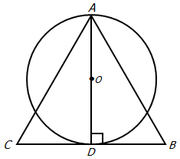
If the circle with center O has area 9\piπ, what is the area of equilateral triangle ABC?
Image

I got r = 3 --> d= 6 = AD
I tried to solve the problem by calculating CD based on the ratio of a 30-60-90 triangle
DC: AD:AC = 1:$$\sqrt{3}$$:2
AD = d = 6 --> DC = 6/$$\sqrt{3}$$
As 2DC = BC --> BC = 2 x 63 = 12$$\sqrt{3}$$
Area of ABC = (BC x AD) / 2 = (12$$\sqrt{3}$$ x 6) / 2 = 36$$\sqrt{3}$$

Sorry that I am totally newbie and don't know how to transfer the square root symbol correctly to my post. And moreover, I don't know why I got this wrong. Can someone help? Thank you very much!
Vi
Join the discussion
Source: — Quantitative Reasoning |

by DrMaths » Thu Feb 01, 2018 9:57 am
truongvi1982 wrote:If the circle with center O has area 9\piπ, what is the area of equilateral triangle ABC?
Image

I got r = 3 --> d= 6 = AD
I tried to solve the problem by calculating CD based on the ratio of a 30-60-90 triangle
DC: AD:AC = 1:$$\sqrt{3}$$:2
AD = d = 6 --> DC = 6/$$\sqrt{3}$$
As 2DC = BC --> BC = 2 x 63 = 12$$\sqrt{3}$$
Area of ABC = (BC x AD) / 2 = (12$$\sqrt{3}$$ x 6) / 2 = 36$$\sqrt{3}$$

Sorry that I am totally newbie and don't know how to transfer the square root symbol correctly to my post. And moreover, I don't know why I got this wrong. Can someone help? Thank you very much!
36sqrt{3} = 12*3/sqrt[3] = 12*sqrt[3]
Join the discussion

by ceilidh.erickson » Mon Feb 05, 2018 8:07 am
truongvi1982 wrote:If the circle with center O has area 9\piπ, what is the area of equilateral triangle ABC?
Image

I got r = 3 --> d= 6 = AD
I tried to solve the problem by calculating CD based on the ratio of a 30-60-90 triangle
DC: AD:AC = 1:$$\sqrt{3}$$:2
AD = d = 6 --> DC = 6/$$\sqrt{3}$$
As 2DC = BC --> BC = 2 x 63 = 12$$\sqrt{3}$$
Area of ABC = (BC x AD) / 2 = (12$$\sqrt{3}$$ x 6) / 2 = 36$$\sqrt{3}$$

Sorry that I am totally newbie and don't know how to transfer the square root symbol correctly to my post. And moreover, I don't know why I got this wrong. Can someone help? Thank you very much!
Your logic is totally correct here! You correctly calculated that CD = 6/(sqrt(3)), so the base CB = 12/(sqrt(3)).

The area of the triangle = (1/2)bh --->
base = CB = 12/(sqrt(3))
height = AD = 6
(1/2)bh = (1/2)(12/(sqrt(3)))(6) = 36/(sqrt(3))

So far, you were totally correct. You didn't show us the answer options that went with this problem, so I'm guessing that you didn't see this answer there and assumed you were wrong. Not true! You just needed to find your answer in a different format.

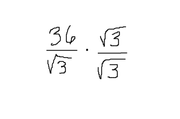
The GMAT doesn't like square roots in DENOMINATORS. The way to get rid of the square root in the denominator is to multiply by (sqrt(3))/(sqrt(3)). In other words, we're multiplying by 1 (so we haven't changed the value), but it's the version of 1 that will get rid of the root in the denominator:
Image

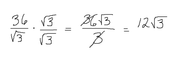
Now, simplify:
Image

Same answer, different format.
Ceilidh Erickson
EdM in Mind, Brain, and Education
Harvard Graduate School of Education
Join the discussion