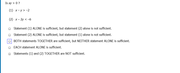
Is xy > 0?
(1) x - y > -2
(2) x - 2y < -6
Oops, looks like I transcribed the question incorrectly (as Rich notes below).
I've edited my response accordingly.
Target question: Is xy > 0?
Statement 1: x - y > -2
Does this provide enough information to answer the
target question with CERTAINTY? No.
Consider these two possible values of x and y that satisfy the given inequality:
Case a: x = 1, y = 1, in which case
xy > 0
Case b: x = -1, y = 0.5, in which case
xy < 0
Since we cannot answer the
target question with certainty, statement 1 is NOT SUFFICIENT
Statement 2: x - 2y < -6
Consider these two possible values of x and y that satisfy the given inequality:
Case a: x = 1, y = 5, in which case
xy > 0
Case b: x = -1, y = 5, in which case
xy < 0
Since we cannot answer the
target question with certainty, statement 2 is NOT SUFFICIENT
Statements 1 and 2 combined
Statement 1 tells us that
x - y > -2
Statement 2 tells us that
x - 2y < -6
IMPORTANT: If we have two inequalities
facing the same direction, we can ADD them together to create a new inequality and, if we're lucky, eliminate a variable.
So, take the inequality in statement 2,
x - 2y < -6, and multiply both sides of the inequality by -1.
We get: -x + 2y > 6
Now take
x - y > -2 and add the inequalities to get...
y > 4. GREAT, this means that y MUST BE POSITIVE
Can we use the fact that
y > 4 to conclude anything about x? Yes.
If we take statement 1, x - y > -2, and add y to both sides, we get: x > y - 2
Now that we know
y > 4, we can be conclude that x > 2. This means that x MUST BE POSITIVE as well.
If x and y are both POSITIVE, we can be certain that
xy > 0
Since we can answer the
target question with certainty, the combined statements are SUFFICIENT
Answer =
C
Cheers,
Brent