ksutthi wrote:Can anyone help me solve this question? I don't seem to be able to derive the answer.
In the xy-plane, at what two points does the graph of y = (x+a)(x+b) intersect the x-axis?
(1) a+b = -1
(2) The graph intersects the y-axis at (0,-6)
Many thanks.
Hi ksutthi!
The real shortcut here is understanding what "solutions" to a quadratic actually mean. Let's think for a moment on a topic that is actually a bit past the scope of the GMAT - the physical shape of a quadratic equation...it is a parabola. And in the world of parabolas, we often want to think about how many times they cross the X axis. From the images below, you can see that a parabola can cross the x-axis one-time, 2-times or 0-times.
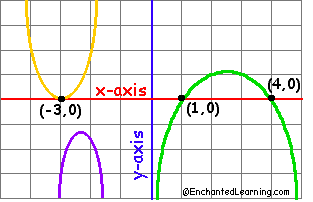
Okay, pretty neeto but so what right?? Well, the fact is that we like to think of these x-intercepts because they are all of the places where the Y value is 0. so when the formula y = ax^2 + bx + c becomes 0 = ax^2 + bx + c... so these are the values of X that would SOLVE that equation. But we know how to solve quadratics when they are =0 right?? We factor and then set each piece to 0. HOLD ON!! This means that the "solutions" of a quadratic are actually the x-intercepts of the quadratic/parabola!!
So guess what, the authors of the question have actually done most of the work for you. They already factored the X side into (x+a)(x+b), so to find x-intercepts, we just need to set the Y=0. This means that the quadratic will cross the x-axis at x=-a and x=-b. We just need to find those values!
Stm(1) a+b=-1
This just means that our 2 intercepts will sum to -1, but that doesn't tell us what their specific values are... For example: 8 and -9 or -4 and 3 would both work... [spoiler]Insufficient!![/spoiler]
Stm(2) The graph intersects the y-axis at (0,-6)
This means that when X=0, Y=-6. Let's plug that in:
-6 = (0+a)(0+b)
-6=ab
There are lots of combinations of a & b that will result in a product of -6 so [spoiler]INSUFFICIENT!![/spoiler]
TOGETHER
So now we have the following 2 equations:
a+b=-1
ab=-6
It would seem as if these 2 equations would be incompatible to actually solve for a and b individually, and you would be correct, BUT we don't really care what a is exactly, or what b is exactly - I'll show you what I mean. Let's solve the equation a+b=-1 for a and substitute into the second equation:
a=-1-b
(-1-b)(b)=-6
-b-b^2=-6
6 - b - b^2 = 0
(3+b)(2-b)=0
b=-3 or b=2
But would this be insufficient?? Well, let's check the values for a that correspond to these b values. We can use a=-1-b to solve:
when b=-3, a=-1-(-3)=-1+3=2
when b=2, a=-1-2=-3
So notice what happens, the a and b just swap values. But since we only care about the intercepts, we don't really care if they are (-3,0) & (2,0) or if they are (2,0) & (-3,0). The notation of a and b is just arbitrary! [spoiler]SUFFICIENT!![/spoiler]
Hope this helps!

Whit
ASIDE: I talked about the number of times a parabola hits the x-axis so here is a fun tidbit of added info!! We determine the number of intercepts by the number of solutions:
- perfect squares (x+a)^2 only touch the x-axis once because their 2 solutions are equal
- typical factored quadratics will cross 2 times because they have 2 unique solutions
- un-factorable quadratics will NOT cross the x-axis because they have NO solution (x^2+a^2) for example)























