BREAKING: Target Test Prep releases Brand New 2026 On Demand GMAT prep course

Redeem

Data suffeciency problem - Geometry

Expert replies
by krishna239455 » Thu Apr 12, 2012 10:59 pm
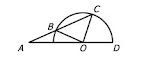
Pls see the attachment for the question.

Let me know the answer and the approach to solve this problem.
Attachments
New Microsoft Word Document.doc
data suffeceincy problem
(29.5 KiB) Downloaded 128 times
Join the discussion
Source: — Data Sufficiency |

by rijul007 » Thu Apr 12, 2012 11:19 pm
IMO B


Image

Angle BAO = Angle BOA

Angle OCB = Angle OBC

Angle BAO =?

Statement 1
Angle COD = 60

We cant find the number of degrees in other angles with this info

Not sufficient

Statement 2
Angle BCO = 40

Angle OBC = 40

Angle ABO = 180-40 = 140
BAO + BOA = 180-140 = 40
2* BAO = 40
BAO = 20

Sufficient

Option B
Join the discussion

by Shalabh's Quants » Fri Apr 13, 2012 3:27 am
I think Ans is D.

We can calculate ang. BAO = 20 from stat. 2 alone as explained by rijul007.

We can also find it from Stat. 1 too.

Say ang. BCO = ang. CBO = x; OB = OC = Radius.

then, ang. BOC = 180 - 2x & ang. OBA = 180 - x ----(1)

In Trangle ABO, since AB = BO, hence ang. BAO = ang. BOA;

=> In Trangle ABO, ang. BAO + ang. BOA + ang.ABO = 180.

=> ang. BAO + ang. BOA = 180 - ang.ABO

=> 2*ang. BOA = 180 -(180-x); By replacing the value of ang.ABO from eqn.1.; also know that we ang. BAO = ang. BOA

=> So, ang. BOA = x/2;

=> again, we can write... ang. BOA + ang. BOC + ang. COD = 180.

=> x/2 + 180 -2x + 60 = 180

=> x = 40. => ang. BOA = x/2 = 40/2 = 20.

Both the statement are sufficient individually. Ans D.
Shalabh Jain,
e-GMAT Instructor
Join the discussion

by Anurag@Gurome » Fri Apr 13, 2012 4:10 am
krishna239455 wrote:Pls see the attachment for the question.

Let me know the answer and the approach to solve this problem.

Refer to the figure below,

Image

OC is the radius of the circle.
Hence, AB = OC implies, AB = OC = OD = OB

Hence, triangle ABO is isosceles with AB = OB.
Hence, angle BAO = angle BOA = x (say)
Hence, angle ABO = (180 - 2x)

Now on straight line AC, angle ABO = (180 - 2x)
Hence, angle CBO = 180 - (180 - 2x) = 2x

Again triangle CBO is isosceles with OB = OC
Hence, angle BCO = CBO = 2x
Hence, angle BOC = (180 - 4x)

Now on straight line AD, (angle AOB + angle BOC + angle COD)= 180
Hence, (x + (180 - 4x) + angle COD) = 180
=> angle COD = 3x

Statement 1: angle COD = 3x = 60
Hence, angle BAO = x = 20; SUFFICIENT.

Statement 2: angle BCO = 2x = 40
Hence, angle BAO = x = 20; SUFFICIENT.

The correct answer is D.
Anurag Mairal, Ph.D., MBA
GMAT Expert, Admissions and Career Guidance
Gurome, Inc.
1-800-566-4043 (USA)

Join Our Facebook Groups
GMAT with Gurome
https://www.facebook.com/groups/272466352793633/
Admissions with Gurome
https://www.facebook.com/groups/461459690536574/
Career Advising with Gurome
https://www.facebook.com/groups/360435787349781/
Join the discussion

by GMATGuruNY » Fri Apr 13, 2012 8:42 am
Image

In the figure shown, point O is the center of the semicircle and points B, C, and D lie on the semicircle. If the length of line segment AB is equal to the length of line sement OC, what is the degree measure of angle BAO?

(1) The degree measure of angle COD is 60.
(2) The degree measure of angle BCO is 40.
The two statements cannot contradict each other.
It must be POSSIBLE for both statements to be true AT THE SAME TIME.
If COD=60 and BCO=40, then the angle measurements are as follows:
Image
The combination above satisfies all of the rules of geometry.
The sum of the angles inside each triangle is 180.
The sum of any angles that form a straight line is 180.
In this case, BAO=20.

Now we need to determine whether it's possible for one statement to be true WITHOUT the other.

Statement 1 alone: COD=60
Let BCO=50, implying the following combination of angles:
Image
The combination above is not valid: ABO+OBC = 100+50 = 150, but the sum of these angles must be 180.
Thus, if COD=60, then IT MUST BE TRUE that BCO=40, implying that BAO=20 (as we saw in the first drawing).
SUFFICIENT.

Statement 2 alone: BCO=40
Let COD=50, implying the following combination of angles:
Image
The combination above is not valid: ABO+OBC = 120+40 = 160, but the sum of these angles must be 180.
Thus, if BCO=40, then IT MUST BE TRUE that COD=60, implying that BAO=20 (as we saw in the first drawing).
SUFFICIENT.

The correct answer is D.

This problem illustrates how the GMAT is not really a math test but a REASONING test.
By taking advantage of how the test is constructed -- that it must be possible for both statements to be true at the same time -- we can quickly see that it is NOT possible for one statement to be true WITHOUT the other.
Private tutor exclusively for the GMAT and GRE, with over 20 years of experience.
Followed here and elsewhere by over 1900 test-takers.
I have worked with students based in the US, Australia, Taiwan, China, Tajikistan, Kuwait, Saudi Arabia -- a long list of countries.
My students have been admitted to HBS, CBS, Tuck, Yale, Stern, Fuqua -- a long list of top programs.

As a tutor, I don't simply teach you how I would approach problems.
I unlock the best way for YOU to solve problems.

For more information, please email me (Mitch Hunt) at [email protected].
Student Review #1
Student Review #2
Student Review #3

Join the discussion

by naughtyboy » Tue Jul 10, 2012 10:01 am
Hi Anurag,
Thanks for very clear explanation.
This really helped.
Join the discussion


















