This particular problem gives us four different numbers on a number line (A, B, C, and D) and tells us the distance between two sets of points (A to B and C to D). We should also note that these points are
not necessarily in alphabetical order. Whenever we have GMAT Quant questions dealing with shapes, graphs, number lines, etc., it's a really good call to draw out examples - this is the visual equivalent of plugging in numbers.) Applying this trick here, and remembering that the distance between A and B is longer than between C and D, we see that our line could look like this:
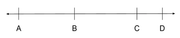
this:
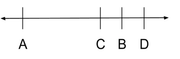
this:
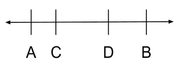
and so on.
We need to find the distance between B and D. This means that we need to gather information
- about the order of the points
- about how our first set of points (A and B) relate to our second set of points (C and D)
Statement 1
If A and B are two different points and are both the same distance from C, this means that the distance between A and C must also be 18 and that C must be directly between the two points like so:
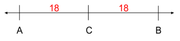
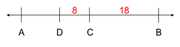
We also know that D is only 8 away from C, so it is closer to C than either A or B. However, we still don't know where D is compared to these points. It could be between points A and C, making it 26 away from B:
or between points C and B, making it 10 away from B:
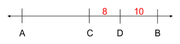
Since we don't know whether the distance between B and D is 26 or 10,
Statement 1 is insufficient.
Statement 2
Statement 2 tells us that A is to the left of D. Well, A is to the left of D in both of the number lines above, and the distance between B and D is not the same in either. So this doesn't tell us much. If the statement told us that A was
directly to the left of D, this might be a little more helpful ... but it didn't and it isn't.
Statement 2 is insufficient.
BOTH
Well, we already established that A is to the left of D (fulfilling Statement 2) in both of the number lines we created to fulfilling Statement 1, so even with the information from both statements, we don't know whether the distance between B and D is 26 or 10. Since we still can't solve for a single solution, the correct answer is E: Statements 1 and 2 TOGETHER are NOT sufficient to answer the question.
We actually featured this problem recently on the
PrepScholar GMAT blog as one of the
5 Hardest Data Sufficiency Questions. I recommend checking out the article for more strategies and trends we can take away from this and other 700+ level problems!