These passages were posed in a home page. Click the links below to access the article. You may also take the free diagnostic to assess your performance.
Paragraph summaries - An approach to main point: Click here
Read the passages and answer the questions to get to the main point. Then view the solution below (next post).

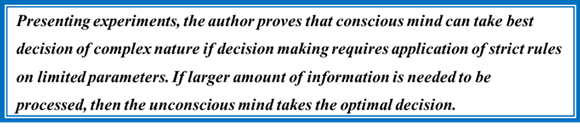
Researchers argue that the brain stem comprising the medulla oblongata, the pons and the mid brain is better at handling a large amount of information. On the other hand, the Cerebral Cortex that is responsible for rational decision making is better at applying very strict, mathematical rules on fewer variables involving well-defined parameters. Consequently, researchers agree that it is better to "sleep on" certain complex decision rather than burn midnight oil to arrive at rationale solution. They believe that in these situations, rationality comes on the way of making a rational decision and that the brain stem is better equipped to handle them than the Cerebral Cortex, arguing that it's better to leave such decisions on unconscious thought process - thinking without paying attention. There are decisions where, the researchers believe, conscious thought outperforms unconscious thought. For example, when a decision requires application of very strict, mathematical rules, conscious thought is beneficial.
Several experiments that incorporated several combinations of plethora of specifications revealed the workings of the brain stem and the Cerebral cortex. In one such experiment, the participants were asked to choose a car from 10 leading brands of automobiles. The researchers gave them just four parameters to consider for their choice - mileage, cost, reliability, and re-sale value, asking them to take instantaneous decision. The participants came up with the second-to-none decision in this scenario, proving that the conscious mind was super-efficient in processing limited amount of data. Keeping all the other conditions fixed the researchers this time asked the participants to sleep on the choice and declare their decision later. The resulting choices that participants made were not as optimal.
In another set of similar experiments, the researchers were baffled by the appalling choices that the test group made when they conducted the same experiment with 10 leading brands, but doubled the parameters, adding such features to consider as brand appeal, durability, safety, and off-road capability. The researchers argued that Cerebral cortex could not make sense of the expanded information set that led to poor decision making. However, the decisions made by another test group that was allowed to sleep on the decision before declaring their choice were much more worthy, even though not as good as the decision produced by the conscious mind that processed fewer parameters. This led the researchers to conclude that our unconscious mind can process larger amounts of information - as long as we give it time to do so. Another suitable situation, according to researchers, to employ the goal-dependent, deliberative process in the absence of conscious attention is when we are low on energy or easily distracted at the time when we are faced with a complex decision to make. Similarly, when in high spirits, it may be better to invoke the conscious mind to arrive at a much more optimal solution.

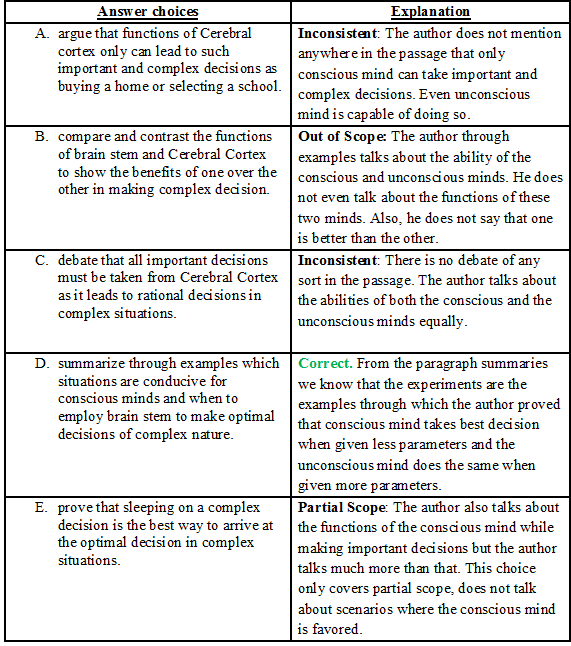
1. The reason why the author has written this passage is that he wants to:
A. argue that functions of Cerebral cortex only can lead to such important and complex decisions as buying a home or selecting a school.
B. compare and contrast the functions of brain stem and Cerebral Cortex to show the benefits of one over the other in making complex decision.
C. debate that all important decisions must be taken from Cerebral Cortex as it leads to rational decisions in complex situations.
D. summarize through examples which situations are conducive for conscious minds and when to employ brain stem to make optimal decisions of complex nature.
E. prove that sleeping on a complex decision is the best way to arrive at the optimal decision in complex situations.

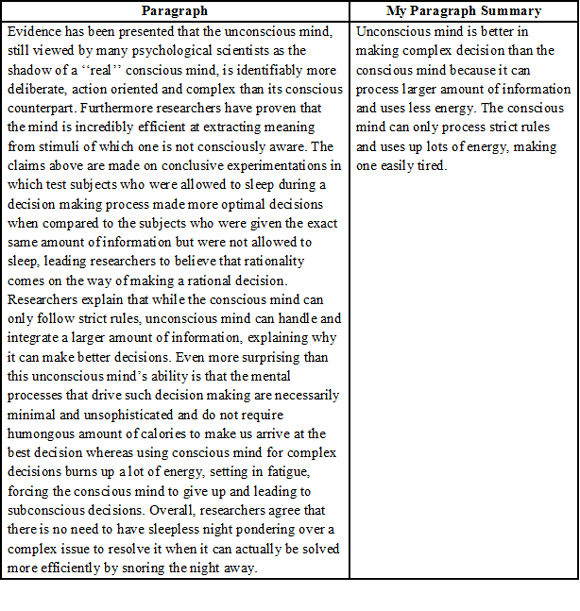
Evidence has been presented that the unconscious mind, still viewed by many psychological scientists as the shadow of a ''real'' conscious mind, is identifiably more deliberate, action oriented and complex than its conscious counterpart. Furthermore researchers have proven that the mind is incredibly efficient at extracting meaning from stimuli of which one is not consciously aware. The claims above are made on conclusive experimentations in which test subjects who were allowed to sleep during a decision making process made more optimal decisions when compared to the subjects who were given the exact same amount of information but were not allowed to sleep, leading researchers to believe that rationality comes on the way of making a rational decision. Researchers explain that while the conscious mind can only follow strict rules, unconscious mind can handle and integrate a larger amount of information, explaining why it can make better decisions. Even more surprising than this unconscious mind's ability is that the mental processes that drive such decision making are necessarily minimal and unsophisticated and do not require humongous amount of calories to make us arrive at the best decision whereas using conscious mind for complex decisions burns up a lot of energy, setting in fatigue, forcing the conscious mind to give up and leading to subconscious decisions. Overall, researchers agree that there is no need to have sleepless night pondering over a complex issue to resolve it when it can actually be solved more efficiently by snoring the night away.
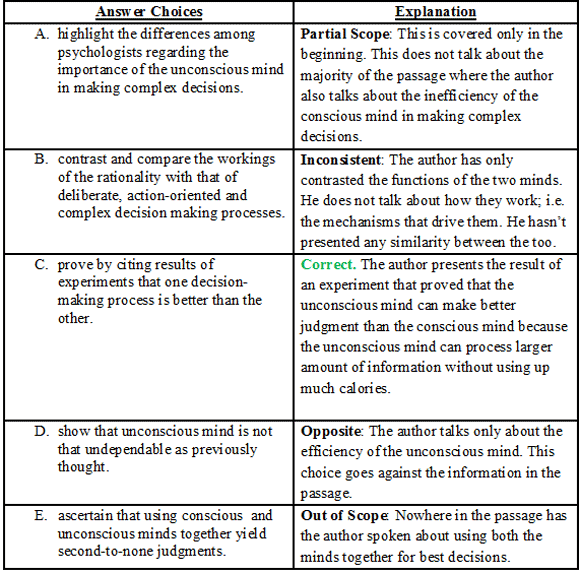
1. The purpose of the passage is to:
A. highlight the differences among psychologists regarding the importance of the unconscious mind in making complex decisions.
B. contrast and compare the workings of the rationality with that of deliberate, action-oriented and complex decision making processes.
C. prove by citing results of experiments that one decision-making process is better than the other.
D. show that unconscious mind is not that undependable as previously thought.
E. ascertain that using conscious and unconscious minds together yield second-to-none judgments.
Thanks.
Paragraph summaries - An approach to main point: Click here
Read the passages and answer the questions to get to the main point. Then view the solution below (next post).
Researchers argue that the brain stem comprising the medulla oblongata, the pons and the mid brain is better at handling a large amount of information. On the other hand, the Cerebral Cortex that is responsible for rational decision making is better at applying very strict, mathematical rules on fewer variables involving well-defined parameters. Consequently, researchers agree that it is better to "sleep on" certain complex decision rather than burn midnight oil to arrive at rationale solution. They believe that in these situations, rationality comes on the way of making a rational decision and that the brain stem is better equipped to handle them than the Cerebral Cortex, arguing that it's better to leave such decisions on unconscious thought process - thinking without paying attention. There are decisions where, the researchers believe, conscious thought outperforms unconscious thought. For example, when a decision requires application of very strict, mathematical rules, conscious thought is beneficial.
Several experiments that incorporated several combinations of plethora of specifications revealed the workings of the brain stem and the Cerebral cortex. In one such experiment, the participants were asked to choose a car from 10 leading brands of automobiles. The researchers gave them just four parameters to consider for their choice - mileage, cost, reliability, and re-sale value, asking them to take instantaneous decision. The participants came up with the second-to-none decision in this scenario, proving that the conscious mind was super-efficient in processing limited amount of data. Keeping all the other conditions fixed the researchers this time asked the participants to sleep on the choice and declare their decision later. The resulting choices that participants made were not as optimal.
In another set of similar experiments, the researchers were baffled by the appalling choices that the test group made when they conducted the same experiment with 10 leading brands, but doubled the parameters, adding such features to consider as brand appeal, durability, safety, and off-road capability. The researchers argued that Cerebral cortex could not make sense of the expanded information set that led to poor decision making. However, the decisions made by another test group that was allowed to sleep on the decision before declaring their choice were much more worthy, even though not as good as the decision produced by the conscious mind that processed fewer parameters. This led the researchers to conclude that our unconscious mind can process larger amounts of information - as long as we give it time to do so. Another suitable situation, according to researchers, to employ the goal-dependent, deliberative process in the absence of conscious attention is when we are low on energy or easily distracted at the time when we are faced with a complex decision to make. Similarly, when in high spirits, it may be better to invoke the conscious mind to arrive at a much more optimal solution.
1. The reason why the author has written this passage is that he wants to:
A. argue that functions of Cerebral cortex only can lead to such important and complex decisions as buying a home or selecting a school.
B. compare and contrast the functions of brain stem and Cerebral Cortex to show the benefits of one over the other in making complex decision.
C. debate that all important decisions must be taken from Cerebral Cortex as it leads to rational decisions in complex situations.
D. summarize through examples which situations are conducive for conscious minds and when to employ brain stem to make optimal decisions of complex nature.
E. prove that sleeping on a complex decision is the best way to arrive at the optimal decision in complex situations.
Evidence has been presented that the unconscious mind, still viewed by many psychological scientists as the shadow of a ''real'' conscious mind, is identifiably more deliberate, action oriented and complex than its conscious counterpart. Furthermore researchers have proven that the mind is incredibly efficient at extracting meaning from stimuli of which one is not consciously aware. The claims above are made on conclusive experimentations in which test subjects who were allowed to sleep during a decision making process made more optimal decisions when compared to the subjects who were given the exact same amount of information but were not allowed to sleep, leading researchers to believe that rationality comes on the way of making a rational decision. Researchers explain that while the conscious mind can only follow strict rules, unconscious mind can handle and integrate a larger amount of information, explaining why it can make better decisions. Even more surprising than this unconscious mind's ability is that the mental processes that drive such decision making are necessarily minimal and unsophisticated and do not require humongous amount of calories to make us arrive at the best decision whereas using conscious mind for complex decisions burns up a lot of energy, setting in fatigue, forcing the conscious mind to give up and leading to subconscious decisions. Overall, researchers agree that there is no need to have sleepless night pondering over a complex issue to resolve it when it can actually be solved more efficiently by snoring the night away.
1. The purpose of the passage is to:
A. highlight the differences among psychologists regarding the importance of the unconscious mind in making complex decisions.
B. contrast and compare the workings of the rationality with that of deliberate, action-oriented and complex decision making processes.
C. prove by citing results of experiments that one decision-making process is better than the other.
D. show that unconscious mind is not that undependable as previously thought.
E. ascertain that using conscious and unconscious minds together yield second-to-none judgments.
Thanks.
Register for free live sessions
Sentence Correction: Get 4 free video lessons, 50 practice questions
Critical Reasoning workshop: Get 4 free video lessons, 40 practice questions
Reading Comprehension: Get 2 free video lessons and 2 free eBooks
Free Strategy Session: Key strategy to score 760
Success Stories
V27 to V42 | V28 to V48 | V25 to V38 | More Success Stories
Sentence Correction: Get 4 free video lessons, 50 practice questions
Critical Reasoning workshop: Get 4 free video lessons, 40 practice questions
Reading Comprehension: Get 2 free video lessons and 2 free eBooks
Free Strategy Session: Key strategy to score 760
Success Stories
V27 to V42 | V28 to V48 | V25 to V38 | More Success Stories