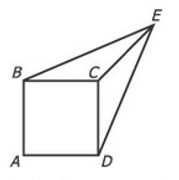
prachi18oct wrote:Hi GMATGuruNY,
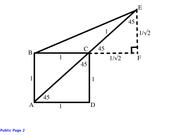
∆ECF:
Since AB || CF, ∠ECF = 45 degrees.
Thus, is a ∆ECF is a 45-45-90 triangle.
How can we assume that CE will overlap with the diagonal of the square extended ? an you please explain how we can take that angle 45 ?
Can the figure not be a 3D figure also?
On page 20 of the OG13, the instructions for the Problem Solving section read as follows:
Figures are drawn as accurately as possible.
All figures lie in a plane unless otherwise indicated.
In my solution above, I was able to discern from the figure given in the question prompt that CE could be extended to vertex A, yielding diagonal AC.
That said, here is a proof:

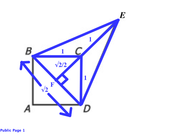
Comparing triangles BCE and ECD, we get:
BE = DE (as stated in the problem).
BC = CD = 1.
Both triangles share side CE.
Since all corresponding sides are equal, ∆BCE and ∆ECD are CONGRUENT.
In congruent triangles, corresponding angles are EQUAL.
Thus, as shown in the figure above, ∠BCE = ∠ECD = 135.
Since ∠BCE = 135, we get the figure shown in my initial post:

Last edited by
GMATGuruNY on Mon Oct 06, 2014 10:46 am, edited 1 time in total.
Private tutor exclusively for the GMAT and GRE, with over 20 years of experience.
Followed here and elsewhere by over 1900 test-takers.
I have worked with students based in the US, Australia, Taiwan, China, Tajikistan, Kuwait, Saudi Arabia -- a long list of countries.
My students have been admitted to HBS, CBS, Tuck, Yale, Stern, Fuqua -- a long list of top programs.
As a tutor, I don't simply teach you how I would approach problems.
I unlock the best way for YOU to solve problems.
For more information, please email me (Mitch Hunt) at
[email protected].
Student Review #1
Student Review #2
Student Review #3