BREAKING: Target Test Prep releases Brand New 2026 On Demand GMAT prep course

Redeem

Target Test Prep · GMAT

Choose how you want to prepare

Learn live with an expert or move at your own pace. Every option includes the complete TTP study system.

★★★★★5.0559 reviews
GMATBootcamp Starts Sep 21
Chris Peckover, Target Test Prep GMAT expert
LIVE ONLINE BOOTCAMP

Live Online Bootcamp Class with Top GMAT Expert Chris Peckover

Sep 21 to Oct 9, 2026

Schedule
Mon to Fri · 7:00 to 10:00 PM ET
Included
Live classes + 6 months of TTP OnDemand
  • Boost your GMAT score in less than one month in a live online class
  • 6 months access to TTP OnDemand video courses included
View bootcamp & enroll
Limited cohort · enrollment openTarget Test Prep
EALiveTeach 5 seats left
Logan Thompson
EXECUTIVE ASSESSMENT

Sep 6 to Dec 6, 2026

with Logan Thompson

Schedule
Sun · 9:30 AM to 12:30 PM ET
Included
40 hours of live online classes plus six months of access to the complete TTP EA OnDemand course.
  • 165+ EA Score Guarantee
  • 4,100+ Quant, Verbal, and Integrated Reasoning practice questions
  • 400+ hours of in-depth video lessons
  • 3,000+ step-by-step video solutions
View EA class & enroll
Limited cohort · enrollment openTarget Test Prep
GMATOnDemand Start anytime
SELF-PACED MASTERCLASS

Target Test Prep GMAT OnDemand

Complete access from day one. Study on your schedule.

715+ score guarantee
$0to start then $127/mo
  • Personalized study plan and analytics
  • Thousands of lessons and practice questions

Compare the format, schedule, and included access before enrolling. Prices and seat counts shown reflect the supplied offer details.

MGMAT 5th Edition - 2 part question

Data Sufficiency, Multi-Source Reasoning, Table Analysis, Graphics Interpretation, Two-Part Analysis
Expert replies
by adigmat2013 » Mon Aug 05, 2013 2:05 pm
Can someone help?

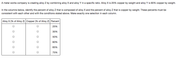
A metal works company is creating alloy Z by combining alloy X and alloy Y in a specific ratio. Alloy X is 25% copper by weight and alloy Y is 65% copper by weight.

identify the percent of alloy Z that is composed of alloy X and the percent of alloy Z that is copper by weight. These percents must be consistent with each other and with the conditions stated above.

Alloy X (% of Alloy Z) Copper (% of Alloy Z) Percent
25%
35%
50%
60%
65%
75%
Join the discussion
Source: — Data Insights |

by adigmat2013 » Mon Aug 05, 2013 2:07 pm
The percentages have come under the wrong column. Basically, there are 3 columns ' Alloy X (% of Alloy Z)', 'Copper (% of Alloy Z)' and 'Percent' and the percentages are under the 'Percent' column. We need to choose the correct percentage from the given options.
Join the discussion

by ceilidh.erickson » Wed Feb 22, 2017 11:39 am
Here is a copy of the question with answer choices:

Image
Ceilidh Erickson
EdM in Mind, Brain, and Education
Harvard Graduate School of Education
Join the discussion

by ceilidh.erickson » Wed Feb 22, 2017 11:51 am
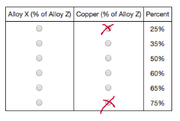
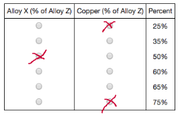
This is a weighted average question. We're being asked: which is a possible combination of answer choices for the percentage of alloy X within alloy Z, and of copper within alloy Z?

Students often get these questions mixed up, because we have two different kinds of percentages to deal with.

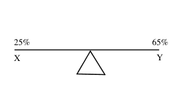
- if the overall mixture were made up of 100% of alloy X, it would have 25% copper

- if the overall mixture were 0% alloy X (100% alloy Y), it would have 65% copper

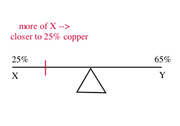
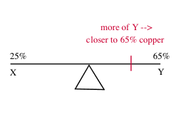
We can represent this kind of weighted average with a scale (or see-saw):

Image

Image

Image

Based on the above, it would be impossible for the amount of copper in alloy Z to be 25% unless the amount of alloy X was 100% (not an option), or to be 65% unless the amount of X was 0% (also not an option).

Image

Now, test some of the other answer choices:

- what if we has 50% of alloy X, 50% of alloy Y? Then we'd be exactly halfway between 25 and 65% copper: 45%. Since that's not an answer option, we can't have 50% of X.
Image

- If we had 25% of X and 75% of Y, we'd have 0.25(25) + 0.75(65) = 55% copper. Not an answer option.

- If we had 35% of X and 65% of Y, we'd have 0.35(25) + 0.65(65) = 51% - not an option

- If we had 60% of X and 40% of Y, we'd have 0.6(25) + 0.4(65) = 41% - not an option

- If we had 65% of X and 35% of Y, we'd have 0.65(25) + 0.35(65) = 39% - not an option

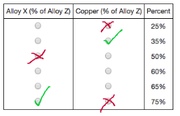
- If we had 75% of X and 25% of Y, we'd have 0.75(25) + 0.25(65) = 35% - BINGO!
Image
Ceilidh Erickson
EdM in Mind, Brain, and Education
Harvard Graduate School of Education
Join the discussion

by ceilidh.erickson » Wed Feb 22, 2017 12:10 pm
One shortcut would be to recognize that weighted averages are PROPORTIONAL.

For example, if you had 5 grams of mixture A that was 20% alcohol, and 10 grams of mixture B that was 50% alcohol, you would have a 1:2 ratio of A:B. The distance between your extreme points (20% and 50%) and the actual amount will be in the same ratio 1:2. Since the total range of possible alcohol percentages is 30 (50 - 20), then the percentage of the total mixture must be 40% (20 away from A's amount, 10 away from B's amount).

In the problem above, you might recognize that the total range is 40 (65% - 25%). Therefore, you might want to start with 25% and 75% for the percentage of alloy X, as that would correspond nicely to a 1:3 or 3:1 ratio out of a total of 4.

For more on weighted averages, see:
https://www.manhattanprep.com/gmat/blog ... -pen-down/
https://www.manhattanprep.com/gmat/blog ... -problems/
https://www.manhattanprep.com/gmat/blog ... lems-easy/
https://www.manhattanprep.com/gmat/blog ... -the-gmat/
Ceilidh Erickson
EdM in Mind, Brain, and Education
Harvard Graduate School of Education
Join the discussion